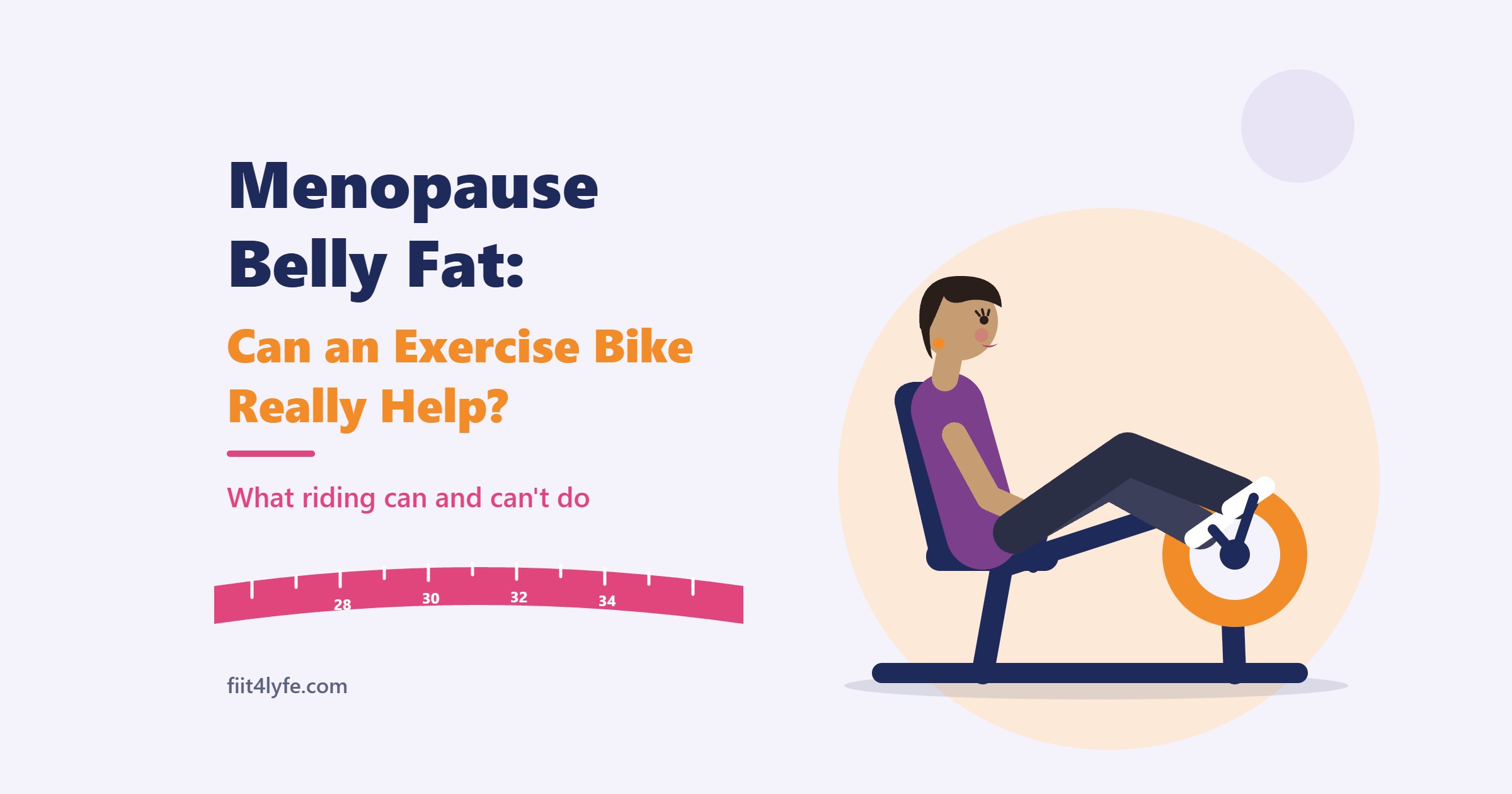
Menopause Belly Fat: Can an Exercise Bike Really Help?
You step on the scale. The number has barely moved. So why won’t your favorite jeans button anymore?
You’re not imagining it. Menopause belly fat is real, and the scale is the worst tool for spotting it.
Menopause shifts where your body stores fat, moving more of it to your belly, often without changing the number on the scale. An exercise bike can’t burn fat from your stomach alone, but regular riding reduces the deep visceral fat around your organs, even without weight loss. Combine riding with strength training and posture work for the biggest change in how your middle looks and how healthy it is.
Why does belly fat increase during menopause?
As estrogen drops, your body gains fat faster and loses muscle, and more of that fat tends to settle around your middle. In a long-term study of more than 1,200 women, the rate of fat gain doubled at the start of the menopause transition while lean muscle began to decline. The scale often doesn’t show it.
That study is the Study of Women’s Health Across the Nation, known as SWAN. A separate four-year study of 156 women found that only those who went through menopause had a significant rise in visceral fat. The good news: in SWAN, the fast shift leveled off about two years after the final period.
Does an exercise bike burn belly fat?
Not directly. No exercise burns fat from one spot. In one study, six weeks of ab exercises, five days a week, didn’t reduce belly fat at all. But riding burns fat across your whole body, and aerobic exercise like cycling is especially good at shrinking visceral fat, the deep belly fat that matters most.
The idea that crunches melt the fat on your stomach is called spot reduction. The ab exercise study, with 24 adults aged 18 to 40, put it to the test. Ab endurance improved, but belly fat, waist size, and skinfolds didn’t change.
Visceral fat, the deep belly fat packed around your organs, is the type of fat most strongly linked to heart disease and type 2 diabetes. It also responds well to regular exercise, even without weight loss.
Can you lose visceral fat without losing weight?
Yes, and this is the best news in this post. A review of 117 studies found that exercise lowered visceral fat by about 6 percent even when people didn’t lose weight, while dieting without weight loss barely changed it. In a small trial, four weeks of cycling cut visceral fat by 12 percent without weight loss.
The review of 117 studies included more than 4,800 people. Its authors concluded that body weight is a poor way to judge whether a healthy routine is working. The cycling trial was small and included adults with obesity.
So measure your waist, not just your weight. Your belly can be getting healthier while the scale stands still.
Is steady riding or HIIT better for belly fat?
Both work. A review of 39 studies found interval training reduced total, belly, and visceral fat. Another review found moderate to hard aerobic exercise had the most potential to shrink visceral fat. Start with steady rides, then add intervals once or twice a week. The best plan is the one you’ll repeat.
HIIT, short bursts of hard work with easy recovery in between, gets a lot of attention, and the 39-study review supports it. One honest note: in that review, running intervals beat cycling intervals for fat loss. But after 50, a bike is easier on your knees and hips, and the workout you can do without pain is the one you’ll keep doing.
When you’re ready for intervals, my guide to HIIT workouts for women over 50 shows you how to start safely.
Does a recumbent bike burn belly fat?
A recumbent bike works the same way as an upright bike. When you ride regularly at a moderate effort, it burns fat across your whole body, including visceral fat. It won’t target your stomach. Its big advantage is comfort: a backrest and an easy step-on help many women ride more often, and how often you ride matters most.
Aim for a pace where you’re breathing harder but can still talk. If you’re choosing a bike, my beginner’s guide to indoor cycling over 50 compares recumbent, upright, and indoor cycling bikes.
Can bad posture make your belly stick out?
Yes. Long hours of sitting tighten your hip flexors, which can tip your pelvis forward. Combined with weak glutes and abs, that tilt pushes your belly out, so it looks bigger than it is. ISSA’s glute training standard calls this pattern lower crossed syndrome. Stretching your hip flexors and strengthening your glutes helps.
That forward tip is called anterior pelvic tilt. Picture your pelvis as a bowl of water spilling out the front. Lower crossed syndrome means tight hip flexors and lower back, with weak glutes and abs.
Try ISSA’s wall test. Stand with your back and heels against a wall. If your whole hand slides easily into the space behind your lower back, your pelvis may be tipping forward. A neutral spine leaves just enough room for a snug hand.
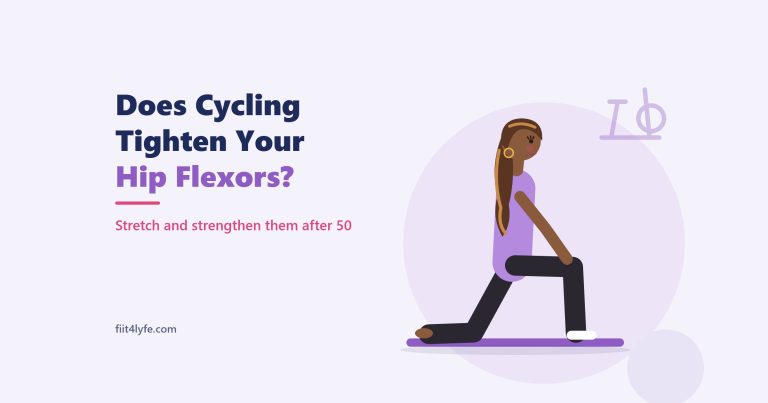
Riding is a seated, hips-bent exercise, so stretch your hip flexors after every ride. Then wake up your glutes with my 5-minute glute activation routine, and strengthen your hip flexors the right way.
Do I need strength training too?
Yes. Menopause speeds up muscle loss, and muscle helps keep your metabolism and blood sugar working in your favor. Two strength sessions a week, covering your legs, hips, back, chest, arms, and core, help protect that muscle. Research shows strength training can also trim a little visceral fat on its own.
Together, riding and lifting cover what the scale can’t see.
Food plays a role too. For the basics, read my post on nutrition for indoor cycling.
| The Myth | The Precision Standard |
|---|---|
| Crunches burn belly fat | No exercise spot-reduces; riding shrinks deep belly fat all over |
| The scale tells the truth | Measure your waist; visceral fat can drop while your weight stays put |
| Only hard workouts count | Steady rides work; add intervals once or twice a week |
| Cardio is all you need | Ride plus two strength days protects the muscle menopause takes |
| A bigger belly is always fat | Part of it can be pelvic tilt from sitting and weak glutes |
My 21-Day Fitness Acceleration Planner lists more than one way to measure progress, because weight is only one tool and getting stronger counts too. So here’s your Daily Win. Measure your waist at your belly button today and write it down. Check it again in four weeks, no matter what the scale says.
Forensic Case File: The scale lied
Let’s look at the evidence. The SWAN researchers followed more than 1,200 women through menopause, scanning their bodies again and again over the years.
On the scale, nothing dramatic happened. Their weight kept climbing at the same slow, steady pace as before. If you only looked at the number, you’d say menopause changed nothing.
The scans told a different story. At the start of the transition, the rate of fat gain doubled and lean muscle started to slip. Same steady climb on the scale, different body underneath. As the lead researcher explained, those changes aren’t captured by the scale.
Here’s what I take from it. Stop letting one number decide how you feel about your body. Track your waist, your strength, and your riding minutes. Those numbers show what’s really changing.
Bottom line: An exercise bike can’t spot-reduce your stomach, but regular riding shrinks visceral fat, the deep belly fat that rises during menopause, even without weight loss. Pair it with two strength days and hip flexor and glute work for the biggest change.
Frequently Asked Questions
How long should I ride an exercise bike to lose belly fat?
Aim for at least 150 minutes of moderate riding a week, such as 30 minutes on five days, plus two strength sessions. If you’re new, start with 15 to 20 minutes twice a week and build up. Consistency over months matters more than any single long ride.
Can a stationary bike reduce stomach fat?
Yes, as part of whole-body fat loss. A stationary bike won’t burn fat from your stomach alone, but regular riding reduces visceral fat, the deep fat inside your belly. Your waist can shrink before the scale moves.
Is cycling better than walking for belly fat?
Both are aerobic exercise, and both can reduce visceral fat. The better choice is the one you’ll do most often at a moderate effort. A bike makes it easy to push a little harder without impact on your knees and hips, and the weather never cancels your ride.
Why is lower belly fat the last to go?
Your body decides where fat comes off first, and you can’t choose the spot. Many women find the lower belly is the slowest place to change. Keep riding and strength training, and check your posture, because a forward pelvic tilt can make the lower belly look fuller than it is.
Does menopause belly fat ever go away?
It can shrink, and the fast shift levels off about two years after your final period. Regular exercise reduces visceral fat in midlife and beyond, so the habits you build now keep working long after menopause.
Has your waist changed more than your weight since menopause? Tell me in the comments.
For a new low-impact workout idea every week, follow me @FiitTalk on Instagram and TikTok.
I’m a certified fitness professional, not a doctor, and this article is for general education, not medical advice. Please check with your doctor before starting any new exercise program, especially if you have heart disease, high blood pressure, diabetes, or joint or back pain.
Sources
- Greendale GA, et al. Changes in body composition and weight during the menopause transition. JCI Insight, 2019.
- Lovejoy JC, et al. Increased visceral fat and decreased energy expenditure during the menopausal transition. International Journal of Obesity, 2008.
- Vispute SS, et al. The effect of abdominal exercise on abdominal fat. Journal of Strength and Conditioning Research, 2011.
- Verheggen RJHM, et al. Exercise training versus hypocaloric diet: distinct effects on body weight and visceral adipose tissue. Obesity Reviews, 2016.
- Johnson NA, et al. Aerobic exercise training reduces hepatic and visceral lipids in obese individuals without weight loss. Hepatology, 2009.
- Maillard F, et al. Effect of high-intensity interval training on total, abdominal and visceral fat mass: a meta-analysis. Sports Medicine, 2018.
- Vissers D, et al. The effect of exercise on visceral adipose tissue in overweight adults. PLOS ONE, 2013.
- Khalafi M, et al. Effect of resistance training with and without caloric restriction on visceral fat. Obesity Reviews, 2021.
- ISSA. Glute Training Specialist course text, Chapter 5.
- U.S. Department of Health and Human Services. Physical Activity Guidelines for Americans, 2nd edition, 2018.