Does Cycling Tighten Your Hip Flexors? How to Stretch and Strengthen Them After 50
You climb off the bike after a great ride and stand up, and your hips don’t want to straighten. For the first few steps, you’re walking like you’re still sitting down.
That stiffness has a name: tight hip flexors from cycling. And it’s one of the easiest problems to fix.
No, cycling doesn’t stretch your hip flexors. It keeps your hips bent the whole ride, which can leave them tight, especially if you also sit a lot. Tight hip flexors can pull on your lower back, make your glutes harder to use, and shorten your stride. A 30-second half-kneeling stretch after each ride, plus simple hip and core strength work twice a week, helps keep them healthy.
Does cycling stretch your hip flexors?
No. On a bike, your hips stay bent through every pedal stroke and never fully open. Add the hours most of us spend sitting, and your hip flexors spend much of the day in a shortened position. Riding is great for your hips in other ways, but it doesn’t stretch the front of them.
Your hip flexors are the group of muscles at the front of your hip that lift your thigh toward your chest. The biggest is the iliopsoas, a deep muscle that runs from your lower spine and pelvis to the top of your thigh. The group also includes the rectus femoris, one of your front thigh muscles.
ISSA’s glute training standard points out that our hips are bent for 60 to 80 percent of the day: sitting, driving, eating, even sleeping curled on our side. A bike ride adds more of the same.
What are the signs of tight hip flexors?
An achy lower back when you stand, trouble standing up straight after sitting or riding, and glutes that are hard to feel when you use them. Some women also notice stiff hips when they walk. ISSA lists lower back ache, poor posture, and trouble engaging the glutes among the common signs of tight hip flexors.
ISSA uses a simple check. Lie on your back on a sturdy bed or bench with your legs hanging off the edge from the knees down. Pull one knee toward your chest and hold it. If your other thigh lifts off the surface instead of resting flat, your hip flexors on that side are likely tight.
See your doctor if you have sharp pain, a pop or snap at the front of your hip, swelling, pain that wakes you at night, or you can’t put weight on the leg.
Can tight hip flexors from cycling cause pain?
They can contribute. Tight hip flexors can tip your pelvis forward, put extra load on your lower back, and leave your glutes doing less of the work. A seat that’s too low or too far forward can make it worse, because it keeps your hips even more bent. Check your bike fit first.
That forward tip is called anterior pelvic tilt. ISSA’s glute training standard explains that when tight hip flexors take over, the glutes can switch off, and smaller muscles such as the piriformis, deep in your buttock, end up overworking. I explain the pelvic tilt and ISSA’s simple wall test in my post on menopause belly fat.
For seat height and position, use the checklist in my post on common indoor cycling mistakes.
What’s the best hip flexor stretch for cyclists?
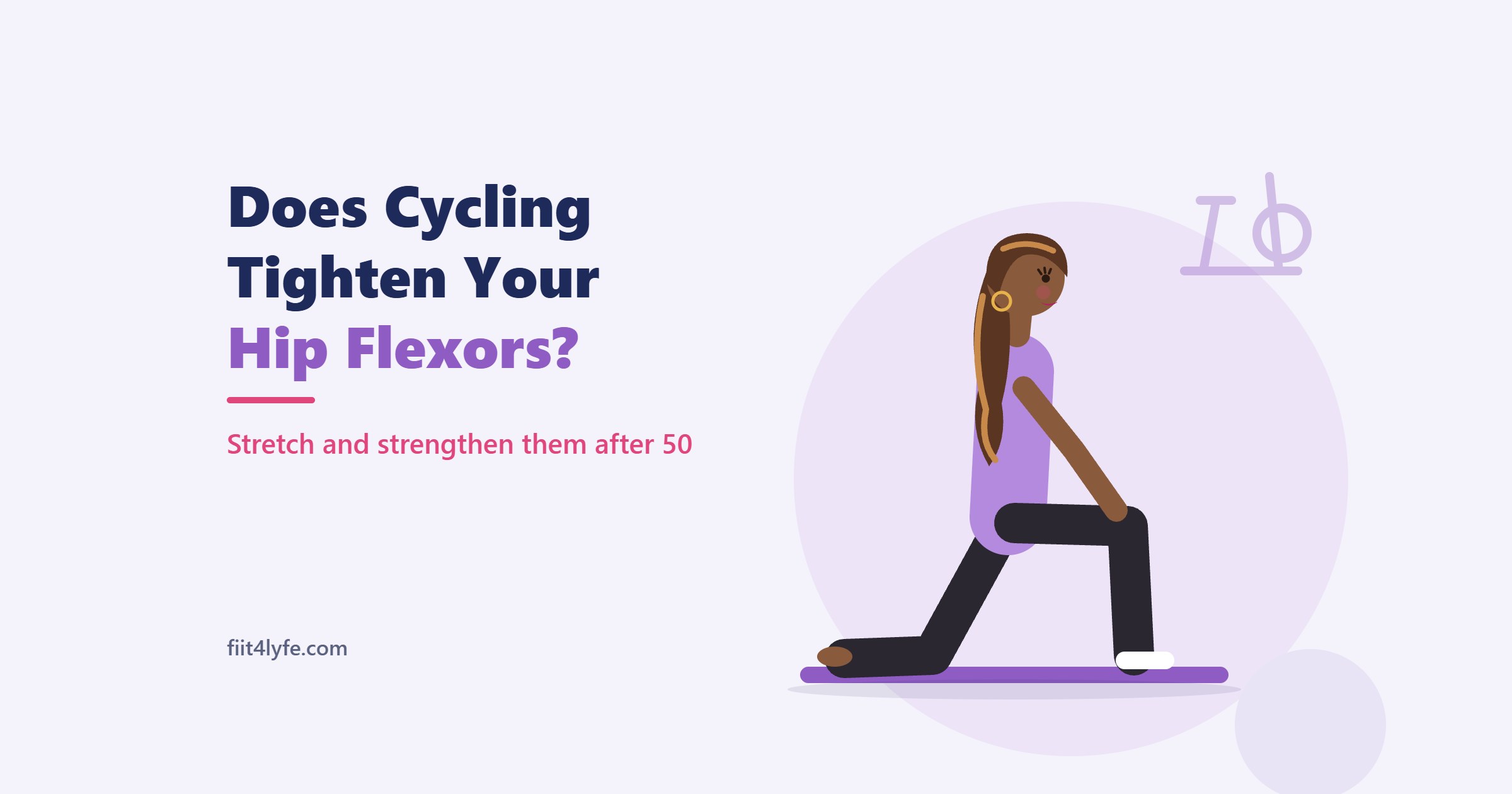
The half-kneeling hip flexor stretch. Kneel on one knee with a cushion under it, step the other foot forward, tuck your hips under slightly, and gently press forward until you feel a stretch at the front of the back hip. Hold 30 to 45 seconds, up to three times per side.
This is ISSA’s go-to stretch for the iliopsoas. Do it after your ride, when your muscles are warm. Keep your chest tall and don’t arch your lower back. The stretch should feel like a gentle pull, never a pinch.
Can’t kneel? Do a standing version. Hold a counter, step one foot back, keep that heel lifted, tuck your hips under, and press forward gently. You’ll feel it in the same spot.
ISSA also suggests foam rolling the front and outside of your thighs before you stretch. If you don’t have a roller, skip it and go straight to the stretch.
Should I strengthen my hip flexors too?
Yes. Tight doesn’t mean strong. Your hip flexors lift your leg on every step and every stair. ISSA notes that a weak core can make the hip flexors take over and tighten. Two short sessions a week of standing marches, seated knee lifts, and core work like dead bugs help keep them strong and balanced.
Here’s a simple routine for your strength days:
| Move | How to do it | Reps |
|---|---|---|
| Standing march | Hold a counter, lift one knee to hip height, lower slowly, switch | 10 per side |
| Seated knee lift | Sit tall at the edge of a chair, lift one knee a few inches, hold 2 seconds | 10 per side |
| Dead bug | Lie on your back, knees bent over hips, slowly lower one heel to tap the floor, switch | 8 per side |
| Glute bridge | Lie on your back, feet flat, lift your hips and squeeze | 10 |
The glute bridge balances the front of your hips with the back. My 5-minute glute activation routine has more moves like it. The U.S. activity guidelines call for muscle strengthening on two or more days a week, so these fit right into that.
Why do hip flexors matter more after 50?
Because they affect how you walk. In a study of older adults, those who had fallen walked with less hip extension than those who hadn’t. In a later trial, a simple hip flexor stretching program lengthened stride in people who started out stiff. Keeping the front of your hips open helps you walk tall and step long.
Hip extension is how far your thigh moves behind your body as you step. When tight hip flexors limit it, your steps get shorter. Research links that pattern to falls, though it hasn’t proven that stretching prevents them.
| The Myth | The Precision Standard |
|---|---|
| Cycling stretches your hips | Riding keeps your hips bent, so stretch them after every ride |
| Tight muscles are strong muscles | Tight and strong aren’t the same, so train both |
| Stretch hard and bounce | Ease in and hold 30 to 45 seconds |
| Hip pain is just age | Check your bike fit, stretch, and strengthen first |
| Only the glutes matter | Your hips, glutes, and core work as a team |
My 21-Day Fitness Acceleration Planner has a rule I come back to again and again: focus on just one or two areas at a time. So here’s your Daily Win. After your next ride, do one half-kneeling hip flexor stretch on each side for 30 seconds before you shower.
Forensic Case File: The stretch that lengthened their stride
Let’s look at the evidence. Researchers led by Dr. Casey Kerrigan compared how older adults walked. Those who had fallen reached their legs back less with each step, about 11 degrees of hip extension compared with about 14 in those who hadn’t fallen.
After an earlier home-stretching trial showed only small changes, the same research group tested a supervised version. In a randomized trial, 82 healthy older adults stretched twice a day for 10 weeks, with a clinician checking in twice a week. One group did a hip flexor stretch. The other stretched their shoulders.
Among those who started with limited hip extension, the hip flexor group walked with longer strides and more hip extension afterward.
Now the honest limits. The participants were older than most of my readers, the changes were modest, and the study didn’t measure falls.
Here’s what I take from it. For people who started out stiff, a simple stretch, done consistently, changed how they walked. Start now, while it’s easy.
Bottom line: Cycling doesn’t stretch your hip flexors; it keeps them bent. After 50, stretch them for 30 to 45 seconds after each ride, and strengthen your hips and core twice a week, to protect your back, wake up your glutes, and keep a long, steady stride.
Frequently Asked Questions
Is biking good for a hip flexor injury?
It depends on the injury. Easy, low-resistance riding is often comfortable during recovery, but a strained or torn hip flexor needs rest first. Ask your doctor or physical therapist before riding through hip pain, and stop if a ride makes it worse.
Why do my hips hurt after indoor cycling?
Common causes are tight hip flexors, a seat set too low or too far forward, or doing too much too soon. Check your bike fit, stretch your hip flexors after each ride, and ease back on time or resistance. If the pain lasts more than a week or two, see your doctor.
How long does it take to loosen tight hip flexors?
Many people notice their hips feel looser within a few weeks of daily stretching. In research on older adults, stride changes showed up after 10 weeks of twice-daily stretching. Consistency matters more than stretching hard.
Should I stretch my hip flexors before or after riding?
After. Hold longer stretches when your muscles are warm, after your ride. Before you ride, use a gentle dynamic warm-up instead, like leg swings and easy pedaling. My warm-up exercises for indoor cycling show you how.
Can tight hip flexors cause back pain?
They can play a part. When your core is weak, your hip flexors can take over the job of steadying your spine, which can leave them tight and your lower back achy. Strengthening your core and hips together usually helps more than stretching alone.
Do your hips feel tight when you climb off the bike? Tell me in the comments.
New to indoor cycling, or getting back to it? Get my free printable plan, Your First 4 Weeks of Low-Impact Riding, with a bike setup checklist and a ride-by-ride schedule.
For a new low-impact workout idea every week, follow me @FiitTalk on Instagram and TikTok.
I’m a certified fitness professional, not a doctor, and this article is for general education, not medical advice. Please check with your doctor before starting any new exercise program, especially if you have hip, back, or knee pain, a hip replacement, or a recent injury.
Sources
- ISSA. Foundations of Glute Training course text, Chapters 5 and 7.
- Kerrigan DC, et al. Reduced hip extension during walking: healthy elderly and fallers versus young adults. Archives of Physical Medicine and Rehabilitation, 2001.
- Kerrigan DC, et al. Effect of a hip flexor-stretching program on gait in the elderly. Archives of Physical Medicine and Rehabilitation, 2003.
- Watt JR, et al. Effect of a supervised hip flexor stretching program on gait in elderly individuals. PM&R, 2011.
- U.S. Department of Health and Human Services. Physical Activity Guidelines for Americans, 2nd edition, 2018.