HIIT Workouts for Women Over 50: Low-Impact Intervals on the Bike
You’re ten minutes into a HIIT class, and the instructor calls out burpees. Then jump squats. Then jumping jacks. Your knees start talking back. You land a little hard and feel it in your pelvic floor. By the cooldown, you’ve already decided HIIT isn’t for you anymore.
Here’s the good news. The jumping was never the point. The intervals were.
HIIT (short bursts of hard work with easy recovery in between) workouts for women over 50 work best when you keep the hard effort and drop the pounding. And there’s no better place to do that than an indoor bike.
Yes, HIIT works for women over 50, and the safest way to do it is low-impact, like short hard pushes on an indoor bike with easy pedaling in between. Research on older adults links interval training to bigger gains in heart fitness and healthier muscle cells. Start with one session a week, keep the hard parts short, and build up slowly.
Is HIIT safe for women over 50?
For most healthy women, yes, when you build up slowly. A five-year study in Norway gave adults aged 70 to 77 interval training twice a week. That group gained the most fitness and reported the best quality of life. Check with your doctor first, especially if you have heart disease, high blood pressure, or joint problems.
That study is called Generation 100, and it was published in The BMJ in 2020. The interval group also had fewer deaths over five years, but that difference was a trend, not a proven effect. Everyone in the study stayed active, and very few people died in any group. The interval group had a small edge that may or may not be real.
ISSA’s indoor cycling standard puts it simply: assess, then progress. Your heart can be ready before your tendons and joints are, so give your body time to adapt.
What does HIIT actually do for your body after 50?
It trains your heart and muscles near their limit in short bursts, then lets them recover. In a Mayo Clinic study, 12 weeks of mostly bike-based interval training improved energy production in muscle cells. The biggest percentage gains showed up in adults aged 65 to 80, not the young group.
Those energy factories are called mitochondria. They tend to decline with age. Intervals helped turn that around.
Two honest notes. First, intervals did little for leg strength in that study. Lifting weights is still how you build strength. Second, you’ll hear a lot about EPOC, the extra calories your body burns while it recovers. It’s real, but ISSA warns it gets oversold as a marketing term. Do intervals for your heart and muscles, not for the afterburn.
Why do HIIT on a bike instead of jumping?
Because you can push hard without the landing. Indoor cycling is non-impact, so your knees, hips, and back don’t absorb a jolt on every rep. You raise the effort by adding resistance or pedaling faster, then you ease off. Your heart responds to effort, whether it comes from jumping or pedaling.
That’s why the burpees, jump squats, and jumping jacks are gone from this guide. ISSA does add one caution. Even without impact, a lot of force goes into those pedals. Build up gradually so your joints and connective tissue keep pace with your heart. One more honest point: the bike doesn’t load your bones the way impact does. That’s one more reason your two strength days matter.
How hard should HIIT feel after 50?
Use a 1 to 10 effort scale. Your hard pushes should land around 7 or 8: breathing hard, able to say only a few words at a time. Your recovery should drop to about 2 or 3, easy enough to hold a conversation. If you track heart rate, ISSA puts intense work at 85 to 95 percent of your maximum.
That effort scale is called RPE (rate of perceived exertion). I like it better than heart rate for most women over 50. Age-based heart rate formulas are only estimates. And some blood pressure medications, like beta blockers, limit how high your heart rate climbs, so heart-rate targets can mislead you. Your breathing tells the truth.
What’s a good beginner HIIT bike workout for women over 50?
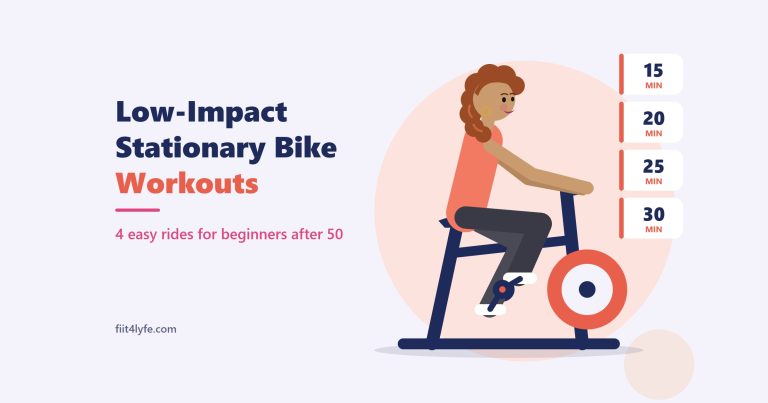
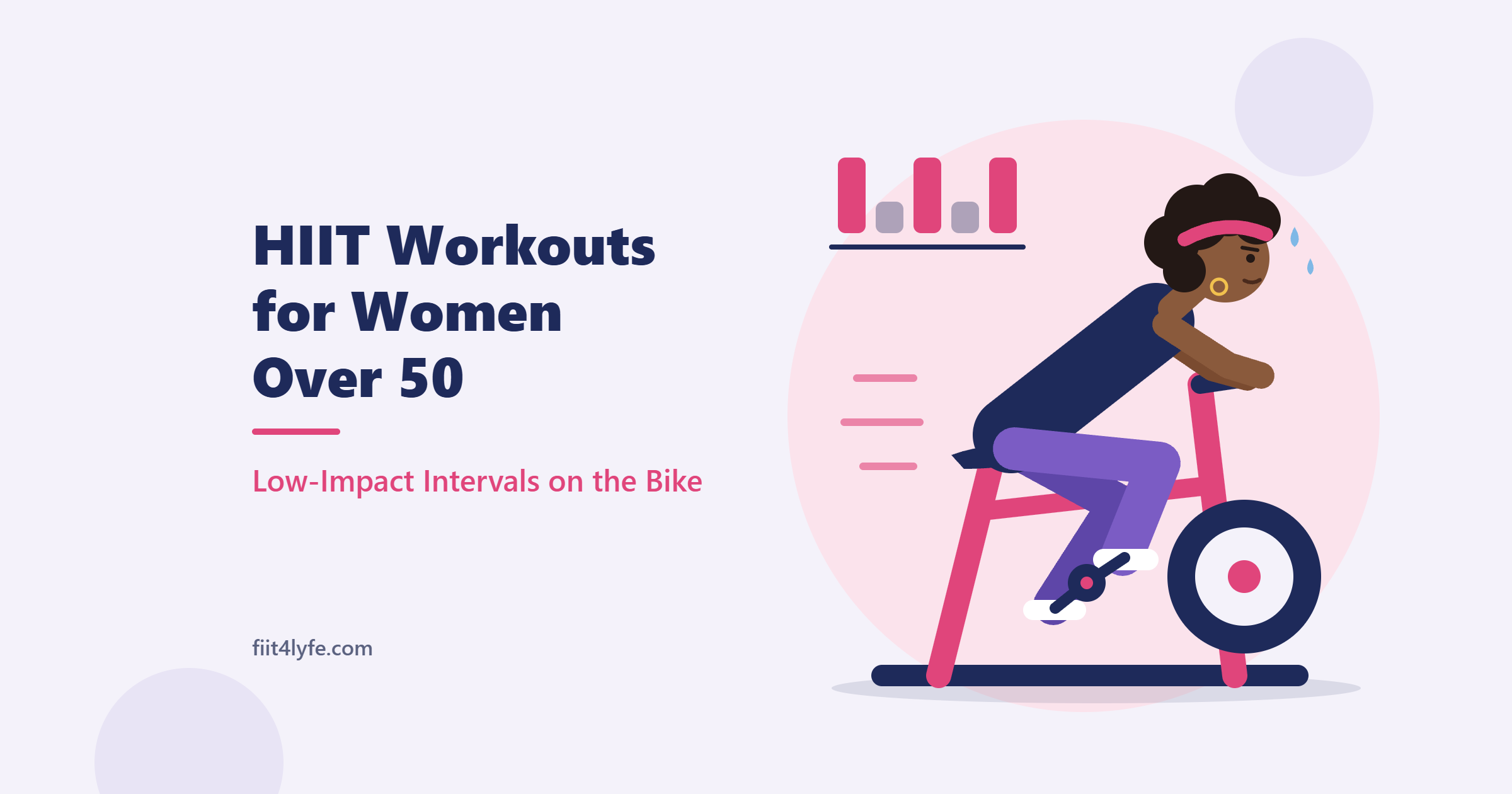
Warm up for 5 to 10 minutes. Then push hard for 30 seconds and pedal easy for 90 seconds. Repeat that 6 times. Cool down for 5 minutes. That’s about 25 minutes total. As it gets easier, shorten the easy part and add rounds. Stay seated until you feel steady on the bike.
| Stage | Hard | Easy | Rounds |
|---|---|---|---|
| Weeks 1 to 2 | 30 seconds | 90 seconds | 6 |
| Weeks 3 to 4 | 30 seconds | 60 seconds | 8 |
| Week 5 and on | 1 minute | 2 minutes | 6 |
| Advanced | 4 minutes | 3 minutes | 4 |
That advanced row is the “4×4” method used in the research above. Save it for when the shorter intervals feel comfortable. For the hard part, you can add resistance and climb, or keep moderate resistance and speed up your legs. Pick whichever feels better on your knees. New to the bike? Start with my guide on how to start indoor cycling over 50 and these common beginner mistakes.
How often should women over 50 do HIIT?
Start with one session a week and build to two, with at least one easier day in between. Fill the rest of your week with steady, comfortable rides and two days of strength training. That mix fits the U.S. activity guidelines and gives your body the recovery it needs.
The Physical Activity Guidelines for Americans call for 150 minutes a week of moderate activity or 75 minutes of vigorous activity, plus muscle strengthening on two or more days. One vigorous minute counts about the same as two moderate ones. For your easy days, try my four easy low-impact bike rides. For strength days, my post on whether an exercise bike tones your bum lists the glute moves I’d start with.
Watch for signs you need a rest day. ISSA suggests checking your resting heart rate. If it’s higher than normal and your legs feel heavy, go easy or take the day off.
| The Myth | The Precision Standard |
|---|---|
| HIIT means jumping, burpees, and pounding | Hard pushes on the bike give your heart a real workout without the impact |
| Go all-out every day | One or two interval days a week, never back to back |
| Push to failure every round | Hard pushes at 7 or 8 out of 10, then real recovery |
| Short rest proves you’re tough | Long rests first, shorter rests as you get fitter |
| Intervals replace strength training | Intervals build fitness. Lifting builds strength. You need both |
My 21-Day Fitness Acceleration Planner has a rule I live by: focus on just one or two areas at a time. So here’s today’s Daily Win. At the end of your next ride, do one round: 30 seconds hard, 90 seconds easy. Next ride, do two. Small steps add up.
Forensic Case File: 20 minutes on the bike, three times a week
Let’s look at the evidence. A study published in Experimental Physiology in 2026, and covered in cycling news in late October, followed 20 active women past menopause. Their average age was 66.6.
For six weeks, they rode three supervised sessions a week, about 20 minutes each. The hard part was just five one-minute efforts with one minute of easy pedaling between them. Afterward, the women burned more fat during moderate exercise and pedaled more efficiently. Their heart-rate patterns during exercise also shifted in ways the researchers linked to better teamwork between the heart and the body’s fuel use. The researchers called the program safe and time-efficient.
Now the honest limits. It was a small group. Everyone was already active. There was no comparison group, and their weight and body composition didn’t change in six weeks.
Here’s what I take from it. Five minutes of hard work, three times a week, was linked to measurable changes in active women averaging 66. These were supervised, carefully set efforts. You don’t need an hour. You need a plan.
Bottom line: HIIT works for women over 50 when it’s low-impact. Short, hard pushes on an indoor bike, one or two sessions a week, build heart fitness and muscle health without the joint pounding of jump-based workouts.
Frequently Asked Questions
Is HIIT good for grandparents and adults over 60?
Yes, for most healthy older adults who build up gradually. The Generation 100 study used twice-weekly intervals with adults aged 70 to 77. Get your doctor’s okay first.
What are the best HIIT workouts for women over 50?
Low-impact ones. Bike intervals, uphill walking intervals, and swimming intervals let you work hard without jumping. The bike is the easiest to control and track.
Can a beginner over 50 start with HIIT?
Yes, but start gently. Ride steadily for a few weeks first, then try 30 seconds hard and 90 seconds easy, once a week.
Does HIIT burn more fat than steady cardio?
Harder riding burns more total calories per minute. Steady, easier riding burns a bigger share of fat. Both help. Doing them consistently matters most.
Can I do HIIT if I have bad knees?
Often, yes, on a bike. Keep the resistance moderate, stay seated, and stop if anything hurts. A doctor or physical therapist can help you adjust.
Have you tried intervals on the bike yet? Tell me your favorite work-to-rest mix in the comments.
For a new low-impact workout idea every week, follow me @FiitTalk on Instagram and TikTok.
I’m a certified fitness professional, not a doctor, and this article is for general education, not medical advice. Please check with your doctor before starting any new exercise program, especially if you have a heart condition or high blood pressure, or take medicine that affects your heart rate.
Sources
- Stensvold D, et al. Effect of exercise training for five years on all cause mortality in older adults: the Generation 100 study. The BMJ, 2020.
- Robinson MM, et al. Enhanced protein translation underlies improved metabolic and physical adaptations to different exercise training modes in young and old humans. Cell Metabolism, 2017.
- Monferrer-Marín J, et al. Six weeks of high-intensity interval training improve autonomic and metabolic responses in active postmenopausal women. Experimental Physiology, 2026.
- U.S. Department of Health and Human Services. Physical Activity Guidelines for Americans, 2nd edition, 2018.
- ISSA. Indoor Cycling course text.