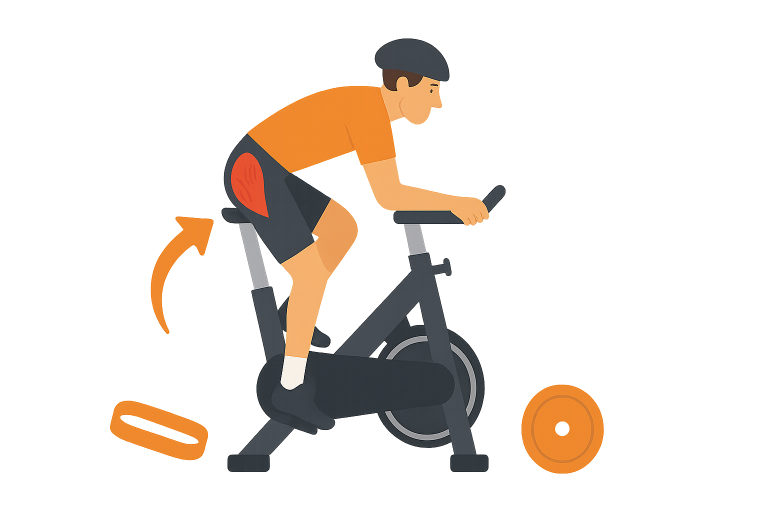
Indoor Cycling for Thigh Toning: Your Guide to Stronger, Defined Legs
Can Indoor Cycling Be the Best Way for Thigh Toning?
Indoor cycling for thigh toning offers a dynamic path to stronger, more defined legs, but is it the solution? If you’ve been wondering whether indoor cycling can really give you those strong, toned thighs you are after, you are not alone. As an ISSA-certified nutritionist and fitness trainer for nearly a decade, I have heard this question more times than I can count.
Here is what I can tell you upfront: regular cycling is a great way to build leg muscles and definition, but it is not a complete, standalone solution. This comprehensive guide will clearly explain what cycling can do for your lower body, its limits, and how to create a complete plan that brings the best results. We will cover everything from the right intensity to the essential strength training workouts needed to truly tone your legs.
Defining the Goal: What is “Strong Thigh Toning”?
The word “toning” is often misused. When people seek “toned thighs,” they typically want two things: muscle definition combined with lower body fat. They want their leg muscles to appear firm and shapely.
Understanding Muscle Tone vs. Muscle Mass
Muscle tone relies on two factors working together:
- Developed muscle tissue underneath the skin.
- Low enough body fat (body fat reduction) for that muscle to be visible.
Think of it this way: developing muscle tone involves making existing muscles more visible through moderate strength work and fat loss. Building significant muscle mass, or “bulking,” involves much heavier resistance training and eating in a calorie surplus. It is very difficult to accidentally get “too bulky” from exercise; it requires years of dedicated hard work.
The Science: Analyzing Which Leg Muscles Indoor Cycling Works
A stationary bike workout provides a comprehensive workout for your lower body, engaging multiple muscle groups with every pedal stroke.
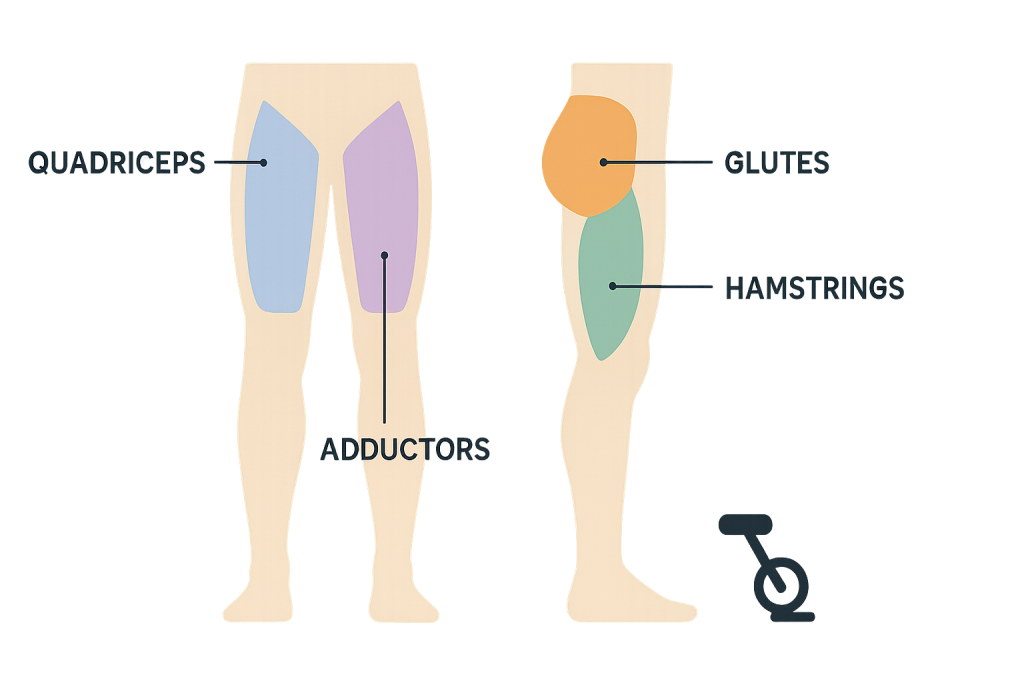
The Primary Lower Body Muscle Groups Engaged
Quadriceps and Hamstrings: The Thigh Powerhouses
Your quadriceps (the four leg muscles on the front of your thighs) are the main drivers during indoor cycling. They fire intensely every time you push down on the pedals.
- Quads: These muscles handle about 60-70% of the work during the downward push of the pedal stroke. When you increase the resistance or stand up (pedaling out of the saddle), your quads work even harder.
- Hamstrings and Gluteal Muscles: These muscle groups assist the downward push and, crucially, activate during the upward pull of the pedal. Proper form is critical here. If you simply push down and neglect the pulling-up motion, you miss out on significant engagement of the hamstring and gluteal muscles. The gluteal muscles fire most intensely when you’re standing or using high resistance.
Supporting Leg Muscles
Beyond the major thigh muscle groups, cycling engages other important areas:
- Calf Muscles: They stabilize your ankle and help with the pulling motion during the upward phase. Regular cycling will develop endurance and muscle definition in your calf muscles.
- Hip Flexors: These deep in your hip muscles work constantly during the upward phase as they lift your knee toward your chest. Balanced training is necessary to prevent them from becoming tight.
Targeting Specific Areas: Inner and Outer Thighs
Here is a necessary truth: while regular cycling is a fantastic way to build overall muscle definition in your thighs, it has significant limitations for targeting your inner thigh muscles.
- Inner Thigh Muscles (Adductors): These muscles bring your legs toward the midline of the body. Since your legs move up and down in a relatively fixed position during cycling, the adductors work mainly as stabilizers, not prime movers. If defined inner thighs are a key fitness goal, you will need supplemental work. These are the elusive adductors.
- Outer Thighs: Similar to the adductors, the outer thighs are engaged for hip stability but do not receive the targeted resistance needed for significant development.
Optimizing Your Indoor Cycling for Thigh Toning
If you want indoor cycling for thigh toning to succeed, you must ride with purpose. The intensity of your workout determines both your calorie burn and the stimulus your leg muscles receive.
Intensity and Interval Training for Fat Loss
Interval training is the most effective method for maximizing results in less time. It alternates between high-intensity bursts and recovery periods, boosting your calorie burn and metabolism.
- Interval Training Example: After a warm-up, perform eight rounds of 30-second sprints at maximum effort, followed by 90 seconds of easy pedaling. The sprints should feel genuinely difficult.
- Benefit: This method efficiently causes fat loss and provides a stronger stimulus for maintaining and developing muscle tone compared to steady-state cardio.
Resistance and Cadence: Finding the Sweet Spot
Customizing your ride by adjusting resistance and cadence (pedaling speed) allows you to target different fitness goals.
- Endurance and Fat Reduction: Use moderate resistance with a higher cadence (80–100 revolutions per minute, or RPM). This approach is an effective aerobic exercise that burns a significant amount of calories. The American Heart Association recommends 150 minutes of moderate-intensity aerobic exercise weekly.
- Building Muscle and Progressive Overload: Use higher resistance with a slower cadence (60–80 RPM). This mimics resistance training and forces your leg muscles to generate more force. Stand up on the bike to simulate climbing, which increases gluteal muscles and hamstring engagement.
- Practical Schedule: A good approach is three cycling workout sessions per week: two focusing on high-intensity interval training and one longer ride with varied resistance.
Ensuring Proper Form on the Exercise Bike
Proper form is vital for both results and injury prevention.
Bike Setup: The Correct Starting Position

Take the time to adjust your bike for maximum lower body engagement:
- Saddle Height: When the pedal is at the bottom of the stroke, your knee should have a slight bend (about 25∘–30∘).
- Saddle Position: When the pedals are horizontal, your forward knee should align roughly over the ball of your foot. This ensures optimal power transfer.
- Handlebar Height: Choose a height that allows you to maintain a comfortable back position throughout your ride.
The Pedal Stroke: Full, Circular Motion
An efficient pedal stroke uses the full, circular motion, not just the downward push:
- Push Down: Primarily uses your quads.
- Pull Back/Up: Engages your hamstrings and hip flexors.
- Focus on applying pressure throughout the entire rotation. Using clipless pedals or toe cages helps you actively pull up, which works more muscle groups.
The Toning Truth: Why Diet and Strength Are Essential
The Reality of Fat Reduction
You must understand the myth of spot reduction: the idea that you can reduce thigh fat or fat in other specific areas by exercising that area. Spot reduction is not supported by science.
- Fat Loss Requires a Calorie Deficit: Reducing thigh fat requires overall body fat reduction. This is achieved through a sustained calorie deficit, meaning you burn more calories than you consume.
- Genetics Determine Fat Loss Pattern: Your body pulls energy from fat stores across your entire body. You cannot choose where the fat comes from first; genetics largely dictates this pattern.
- The Two-Pronged Approach: Achieving visible muscle definition requires attacking the problem from both angles:
- Maintain and build muscle mass through exercise like indoor cycling and resistance training.
- Reduce the fat covering that muscle through a calorie deficit created by a balanced diet and increased activity.
The Right Equipment: Spin Bike vs. Recumbent Bike
The type of exercise bike matters for high-intensity work:
- Spin Bike (Indoor Cycling Bike): Best for high-intensity work, allowing for standing climbs and aggressive interval training. It’s the best way to get intense lower-body recruitment for toning.
- Recumbent Bike: Provides a comfortable, reclined position with lower back stress. However, it limits your ability to stand or perform intense sprints, offering less overall muscle strength development for toning.
For indoor cycling for thigh toning specifically, a spin bike or standard upright bike will yield the best results due to the variety of intensity options.
Complementary Strength Training for Comprehensive Thighs
Indoor cycling cannot stand alone if comprehensive thigh development is your fitness goal. Weight training fills the gaps, especially for the inner thigh muscles.
Strength Sessions for the Lower Body
Your dedicated leg workout should complement cycling by emphasizing movements that cycling under-utilizes. I recommend three to four cycling sessions plus two dedicated strength sessions each week.
Compound Movements: Building Overall Muscle Mass
These exercises involve multiple joints and muscle groups for efficient strength building:
- Squats: The foundational leg workout, working quads, hamstrings, gluteal muscles, and core. Start with body weight to master proper form, then progress to free weights (goblet or barbell squats).
- Lunges: Great for single-leg strength and correcting imbalances. Step forward with your right leg (or left leg), lowering until both knees form 90∘ angles.
- Leg Presses: Provide focused strength development. Adjusting foot placement can target hamstrings and gluteal muscles (feet higher) or quads (feet lower).
Dedicated Exercises for Elusive Adductors (Inner Thighs)
These exercises target the inner thigh muscles that cycling neglects:
| Exercise | Actionable Insight |
|---|---|
| Seated Leg Adduction Machine | Use controlled movements with a hold time. Squeeze your thighs together and pause for 2-3 seconds at the peak contraction. Aim for 3-4 sets of 12-15 repetitions. |
| Side-Lying Leg Lift | Performed in the comfort of your own home with no equipment. Lie on your right side, bend your left leg and place the left leg foot flat in front of the right leg. Lift the straight right leg 6-8 inches off the ground, hold briefly, then lower with control. |
| Resistance Band Adduction | Loop a resistance band around both ankles and perform controlled side-steps, or anchor a band and pull your leg across your body weight toward the midline of the body. |
Progressive Overload and Consistency
Progressive overload is necessary for continued results. As your body adapts, you must gradually increase the challenge:
- Add more resistance on the bike or increase the interval intensity.
- Lift heavier free weights or perform additional repetitions in your strength work.
- Consistency matters: Regular cycling and strength sessions, at least three times per week, are necessary to see meaningful changes in your thigh muscles and body composition.
Your Final Blueprint for Toning Success
Indoor cycling is an excellent way to achieve your weight loss goals and strengthen your major leg muscles. The most effective method for total thigh toning is a balanced approach:
Summary of the Best Results Strategy
- Cycling: Three to four sessions weekly, including at least two high-intensity interval training sessions for maximum calorie burn and fat loss.
- Strength Sessions: Two dedicated leg day workouts weekly. Focus on squats, lunges, and 2-3 specific inner and outer thighs exercises.
- Nutrition: Maintain a modest calorie deficit (300–500 calories daily) for sustained fat reduction. Prioritize protein (0.7–1 gram per pound of body weight) to support building muscle and recovery.
- Recovery: Aim for 7-9 hours of sleep nightly. Allow rest days and avoid training the same muscle groups intensely on consecutive days.
Achieving strong, defined thighs takes patience. You will first notice improved strength and endurance. Visible changes in muscle definition follow as you reduce body fat and build muscle strength simultaneously. Indoor cycling for thigh toning is powerful when used as a pillar in this comprehensive, three-part plan.