Common Indoor Cycling Mistakes: 10 Easy Fixes for Women Over 50
Five minutes into your ride, your knees ache, your hands are tingling, and your seat is already complaining. You figure that’s just what indoor cycling feels like.
It isn’t. Most of that comes from a handful of indoor cycling mistakes that take less than a minute each to fix.
The most common indoor cycling mistakes are a seat set too low, pedaling with almost no resistance, gripping the handlebars too hard, and starting out too fast. Each one is easy to fix: set your seat at hip height, add enough resistance to feel the road, keep a light grip, and ride at a pace where you can still talk. After 50, also wait to stand until you feel steady, and build in rest days.
What are the most common indoor cycling mistakes?
The big four are a seat that’s too low, pedaling with too little resistance, a death grip on the handlebars, and riding too hard too soon. After 50, add two more: standing before your balance is ready, and skipping rest days. Every one of them is easy to fix in a minute or less.
Here are all 10, with the fix for each:
| # | Mistake | The fix |
|---|---|---|
| 1 | Seat too low (or too high) | Seat at hip height, soft knee bend at the bottom |
| 2 | Seat too far forward or back | Front knee over the pedal when the pedals are level |
| 3 | Handlebars too low or too far | Raise them until your back and neck relax |
| 4 | Pedaling with no resistance | Add enough to feel the road |
| 5 | Grinding too much resistance | Ease off until your legs turn smoothly |
| 6 | The death grip | Light, firm hands and straight wrists |
| 7 | Locked elbows and dropped heels | Soft elbows, heels slightly up |
| 8 | Going all-out in week one | Ride at a pace where you can talk |
| 9 | No rest days | Check your morning heart rate and rest when it’s high |
| 10 | No warm-up, cool-down, or water | 3 to 5 easy minutes on each end, bottle in reach |
Is my bike set up wrong?
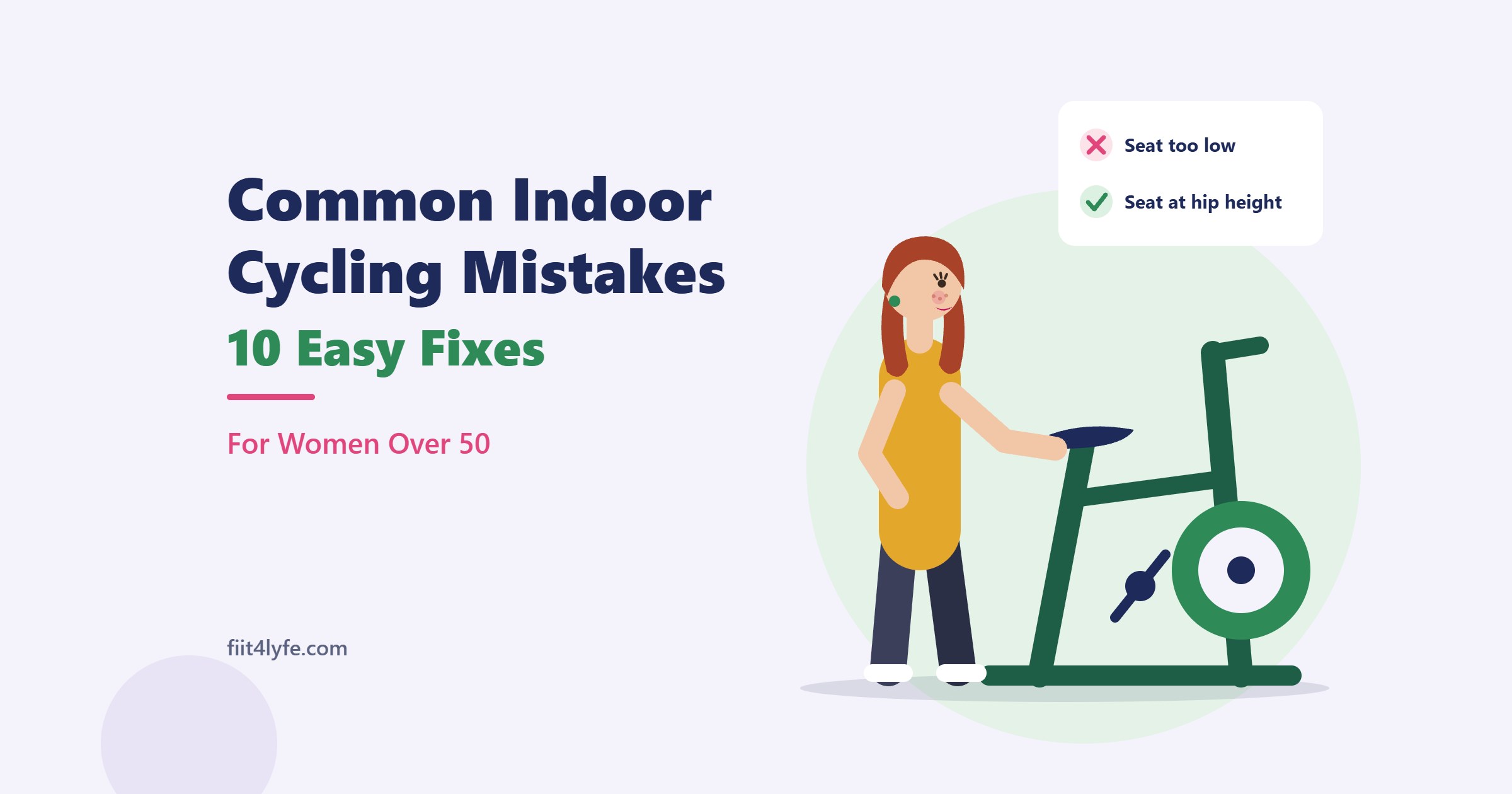
Probably, if your knees or back hurt. Most riders set the seat where it feels comfortable instead of where it works best, and comfortable is usually too low. Set it at hip height so your knee keeps a soft bend at the bottom of each stroke. Then raise the handlebars if your back complains.
Mistake 1: the seat is too low or too high. Stand beside the bike and line the seat up with the top of your hip. Sit down, put your heel on the pedal at the bottom of the stroke, and your leg should be straight. When you pedal on the ball of your foot, your knee keeps a soft bend, about 27 to 37 degrees in ISSA’s bike fit standard. ISSA’s quick checks: if your hips rock side to side, the seat is too high. If your thigh rises above level at the top of the stroke, it’s too low.
Mistake 2: the seat is too far forward or back. Use the KOPS rule (Knee Over Pedal Spindle). With the pedals level, your front knee should sit right over the center of the pedal. Slide the seat until it does.
Mistake 3: the handlebars are too low or too far away. That strains your neck, shoulders, and lower back. ISSA notes that riders with back concerns are often more comfortable with the handlebars set higher. Your elbows should stay softly bent.
My beginner’s guide to indoor cycling over 50 walks through the full setup step by step.
How much resistance should I use?
Enough to feel like you’re riding on a road, never zero. With no resistance, the flywheel spins your legs instead of the other way around, and you bounce in the saddle. Too much, and your knees grind. For steady riding, aim for about 80 to 100 pedal turns a minute; seasoned riders often go faster. For seated climbs, 60 to 80.
Mistake 4: pedaling with no resistance. An indoor bike’s flywheel keeps turning once it gets going. ISSA warns that a rider who spins too fast can lose control of the pedals, and a moving pedal can cause a real injury. If you’re bouncing in the seat, add resistance.
Mistake 5: grinding a heavy load at a crawl. Pushing hard at a very slow pace can put more pressure on your kneecaps. ISSA notes that a quicker, lighter spin puts less stress on the knee joints. Ease off until your legs turn smoothly.
To check your pedal speed, ISSA’s trick works on any bike: rest a hand on your thigh, count how many times your thigh taps it in 10 seconds, and multiply by six.
What am I doing wrong with my posture?
Most beginners grip the handlebars too hard and lock their elbows. Hold the bars with a light but firm grip, keep your wrists straight, and keep a soft bend in your elbows. Let your upper body stay relaxed while your legs do the work, and don’t let your heels drop on the downstroke.
Mistake 6: the death grip. A tight grip leads to tingling hands and tight shoulders. ISSA’s standard is a light but firm grip with neutral wrists, neither bent up nor bent down. If your hands go numb, change hand positions often.
Mistake 7: locked elbows, a rounded back, and dropped heels. Keep your elbows slightly bent and your chest open. From the side, your heel should stay slightly higher than the ball of your foot through the whole stroke.
Am I riding too hard or too often?
If you’re sore, tired, and dreading your next ride, probably. Start at a pace where you can still talk, twice a week, and build slowly. Check your resting heart rate in the morning. If it’s higher than usual and your legs feel heavy, take the day off or ride easy.
Mistake 8: going all-out in week one. I made this one myself. My first indoor cycling class nearly made me quit, and I tell that story in my beginner’s guide. On a 1 to 10 effort scale, your first rides should feel like a 3 or 4.
Mistake 9: no rest days. ISSA lists the warning signs of doing too much: a higher resting heart rate, trouble sleeping, feeling stale or irritable, losing interest in training, getting sick more often, and soreness that won’t go away. If you notice them, ease off. If they don’t improve, see your doctor.
What do beginners forget before and after a ride?
The warm-up, the cool-down, and water. Spend 3 to 5 minutes pedaling easy before you push, and 3 to 5 minutes easing down after. Keep a water bottle within reach and a fan pointed at you. Indoor rides get hotter than you’d expect, because there’s no breeze to cool you down.
Mistake 10: skipping the bookends. A warm-up gets your heart, muscles, and joints ready to work, and a cool-down lets your heart rate come down gradually. My warm-up exercises for indoor cycling give you a simple routine, and my guide to breathing on the bike helps you settle into a steady rhythm.
When should I stand up on the bike after 50?
Only once seated riding feels steady and easy. Add resistance first, keep both hands on the bars, and stand for short stretches, like 20 to 30 seconds. Skip standing if your balance or knees say no. Seated climbs still give you a great workout and work your glutes when you sit back.
ISSA’s standard for standing is simple: shift your weight over the pedals, keep your knees clear of the handlebars, and add resistance before you rise so the pedals don’t run away from you. For more on sitting back to use your glutes, read how to activate your glutes while cycling.
| The Myth | The Precision Standard |
|---|---|
| Set the seat wherever it feels comfortable | Set it at hip height with a soft knee bend at the bottom |
| Faster legs mean a better workout | Add resistance; never pedal against nothing |
| Hold on tight | A light grip and soft elbows |
| Go hard to see results | Ride easy enough to talk, then build |
| Rest days are for quitters | Rest days are when your body adapts and recovers |
My 21-Day Fitness Acceleration Planner has a rule that fits this list perfectly: focus on just one or two areas at a time. So here’s your Daily Win. Pick one mistake from this list and fix only that one on your next ride.
Forensic Case File: Comfortable isn’t the same as correct
Let’s look at the evidence. In a small study presented at the International Society of Biomechanics in Sports, researchers asked 28 college-aged occasional riders, 14 women and 14 men who cycled once or twice a month, to set their own seat height for comfort.
On average, they set it too low. At the bottom of the pedal stroke, their knees bent about 40 to 44 degrees, well past the 25 to 30 degree range that research suggests for protecting the knees. ISSA’s 27 to 37 degree standard points the same way: a soft bend, not a deep one.
That matters. A major review of saddle height research in Sports Medicine found that the lower the seat, the more pressure there tends to be on the kneecap. It also found that knee pain from overuse is common among cyclists.
Most riders never learn that seat height matters. They go for what feels comfortable, not what works best. Take one minute, do the heel test, and give your knees a better ride every time.
Bottom line: The most common indoor cycling mistakes are a seat set too low, too little resistance, a tight grip, and starting too hard. After 50, set your seat at hip height, ride with real resistance at a talking pace, stand only when steady, and take rest days.
Frequently Asked Questions
How do I ride an exercise bike correctly?
Set your seat at hip height with a soft knee bend at the bottom of the stroke. Add enough resistance to feel the road, keep a light grip and soft elbows, and ride at a pace where you can still talk. Warm up and cool down for a few minutes each time.
Why do my knees hurt on an exercise bike?
A seat that’s too low is a common cause, because it puts more pressure on the kneecap. A seat too far forward or too much resistance can also strain your knees. If the pain continues after you adjust your bike, check with your doctor or a physical therapist.
Why does my bottom hurt on an exercise bike?
Some soreness is normal in your first few rides. Keep your seat level and at the right height, and try padded shorts or a gel seat cover.
Why do my hands go numb when I ride?
Usually from gripping too hard or leaning on the handlebars. Loosen your grip, keep your wrists straight, change hand positions often, and try padded gloves.
Is it bad to ride an exercise bike with no resistance?
Yes. With no resistance, the flywheel controls your legs, and you can bounce or lose control of the pedals. Always keep enough resistance that you feel the pedals push back, even on easy days.
Which of these mistakes were you making? Tell me in the comments.
New to indoor cycling, or getting back to it? Get my free printable plan, Your First 4 Weeks of Low-Impact Riding, with a bike setup checklist and a ride-by-ride schedule.
For a new low-impact workout idea every week, follow me @FiitTalk on Instagram and TikTok.
I’m a certified fitness professional, not a doctor, and this article is for general education, not medical advice. Please check with your doctor before starting any new exercise program, especially if you have knee, hip, or back pain, balance concerns, or a heart condition.
Sources
- ISSA. Indoor Cycling course text (bike fit, riding techniques, flywheel safety, overtraining).
- Bini R, Hume PA, Croft JL. Effects of bicycle saddle height on knee injury risk and cycling performance. Sports Medicine, 2011.
- Wicke J, Postma N, Turner M. Preferred saddle height in relation to comfort among female and male occasional cyclists. ISBS Proceedings Archive, 40(1), Article 181, 2022.