Strength Training for Women Over 50: How to Add It to Your Bike Week
You lift the case of water out of the trunk and feel it in your back before you reach the door. You rode three times this week. So why does a case of water feel this heavy?
Because your bike and your muscles are doing two different jobs. Strength training for women over 50 fills the gap the bike leaves behind.
Women over 50 should strength train at least two days a week, even if they ride regularly, because cycling builds endurance but does little for upper-body strength and bone. Start with six simple moves, like sit-to-stands, glute bridges, rows, and wall push-ups, for 20 to 30 minutes on non-riding or easy days. A large 2026 review found that women after menopause gained strength about as well as women before menopause.
Is indoor cycling enough exercise for women over 50?
It’s a great start, but it isn’t enough on its own. Cycling builds your heart, lungs, and leg endurance. It does little for your upper body, and because the bike holds your weight, it does little to load your bones. A review of 31 cycling studies found that road cycling doesn’t appear to build bone. Federal guidelines call for muscle-strengthening work at least two days a week on top of cardio.
Those guidelines say adults should work all the major muscle groups, meaning legs, hips, back, chest, abs, shoulders, and arms, on two or more days a week. Adults 65 and older should add balance training too, and there’s no reason to wait until then to start. Your rides cover the cardio part beautifully. Strength days cover the rest.
Why does strength training matter more after menopause?
When estrogen drops, many women lose muscle and bone faster than before. A review in the Journal of Musculoskeletal and Neuronal Interactions tied falling estrogen at menopause to losses in muscle mass and strength, and named low activity and low protein intake as the main risks we can change. Less muscle can mean less strength for everyday jobs, like carrying groceries, climbing stairs, or getting up off the floor. Strength training is one of the best tools we have to slow that loss and keep doing those jobs on our own.
Muscle also helps on the bike. Strong glutes and hips can help keep your knees tracking straight and may take some strain off your lower back. That’s why I call strength days part of my riding, not a break from it.
Is it too late to build muscle after 50?
No. A 2026 review of 126 studies and more than 4,000 women found that women after menopause gained strength about as well as women before menopause. A separate 2026 trial found that inactive women after menopause built more muscle and strength in just 15 weeks. Your muscles still respond. They just need a reason.
You’ll find the details in the case file below.
How often should women over 50 do strength training?
Two or three days a week, with at least a day between sessions that work the same muscles. Each session can take 20 to 30 minutes. Start light, with 1 or 2 sets of 10 to 15 easy repetitions, and add a little weight or a few reps every couple of weeks as moves start to feel easy.
A repetition, or rep, is one full movement, like standing up from a chair once. A set is a group of reps done back to back. Pick a weight that lets you finish each set with good form and a couple of reps left in the tank.
Mild soreness for a day or two after a new workout is normal. Sharp pain or joint pain is not. Stop that move and try an easier version.
What are the best exercises for strength training for women over 50 at home?
Choose six simple moves that cover your whole body: sit-to-stands from a chair, glute bridges, a hip hinge with light dumbbells, a dumbbell or band row, wall or counter push-ups, and side steps with a mini band. They need little space, no jumping, and they strengthen the muscles that power your ride.
| Move | What it works | Form cue |
|---|---|---|
| Sit-to-stand | Thighs, glutes | Stand up through your heels, then sit back down slowly |
| Glute bridge | Glutes, back of the thighs | Squeeze your glutes to lift your hips; don’t arch your lower back |
| Hip hinge with dumbbells | Glutes, hamstrings, back | Push your hips back with a long, flat back, like closing a car door with your hips |
| Dumbbell or band row | Upper back, arms | Pull your elbow back toward your hip, shoulders down |
| Wall or counter push-up | Chest, shoulders, arms | Keep your body in a straight line from head to heels |
| Side steps with a mini band | Side of the hips | Stay low and keep tension on the band the whole time |
If bridges are new to you, my post on how to activate your glutes while cycling walks through them step by step. Want more challenge later? Use a lower chair, a heavier band, or slightly heavier dumbbells.
How do you fit strength training into a cycling week?
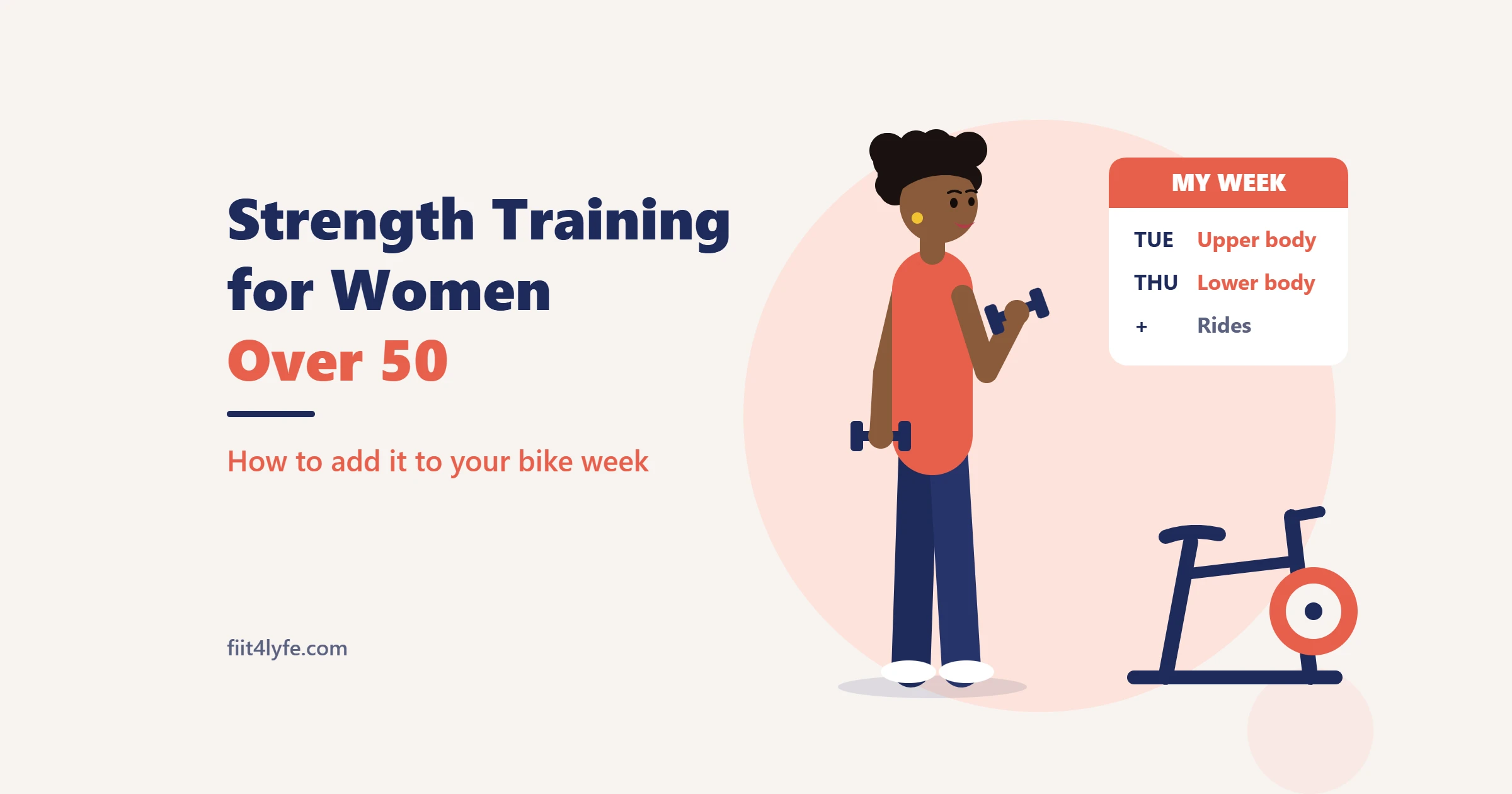
Put strength on non-riding days or after an easy ride, and keep hard rides and hard leg days apart. Here’s how I do it: upper body on Tuesday, lower body on Thursday, and my rides on the other days. Splitting it this way gives my legs a full day to recover before and after my lower-body work.
| Day | Plan |
|---|---|
| Monday | Easy to moderate ride |
| Tuesday | Upper-body strength |
| Wednesday | Interval ride |
| Thursday | Lower-body strength |
| Friday | Easy ride or rest |
| Saturday | Longer easy ride |
| Sunday | Rest |
For the rides, my four easy low-impact bike rides work well on easy days, and my low-impact HIIT intervals fit Wednesday. Adjust the days to your life. What matters is two strength days a week, every week.
Do you need to eat differently when you start lifting?
You need enough food, especially protein, not less. Build meals around whole foods with protein, like eggs, fish, beans, lentils, and Greek yogurt or a plant-based alternative. Crash dieting while you start lifting works against you, because your muscles need fuel to recover and grow.
Expert groups on healthy aging, like the PROT-AGE Study Group, recommend that adults over 65 eat at least 1.0 to 1.2 grams of protein per kilogram of body weight each day, and more for people who are active. Many experts use similar targets for active women in their 50s. That’s a general guide, not a personal target. If you have kidney disease or another health condition, ask your doctor what’s right for you.
And if weight loss is one of your goals, here’s the part most people miss: when you lose weight by any method, some of what you lose is muscle. Strength training helps you keep the muscle you want to keep while the fat comes off. My post on nutrition for indoor cycling covers protein and water in more detail.
| The Myth | The Precision Standard |
|---|---|
| Cardio is all you need | Ride for your heart, lift for your muscles and bones |
| Lifting will make you bulky | Two short sessions a week make you stronger, not bulky |
| It’s too late to build muscle after 50 | Women after menopause gain strength about as well as women before menopause |
| Go heavy or go home | Start light and add a little every couple of weeks |
| Eat less to see results | Eat enough whole food, with protein at each meal |
Here’s your Daily Win: on your next non-riding day, do one round of the six moves above, 10 reps each. Write down one move that felt easier than you expected.
Forensic Case File: What happened when researchers pooled 126 strength studies in women
Let’s look at the evidence. A team led by Eduard Isenmann pulled together 126 resistance training studies in healthy women, 4,019 women in all, with an average age of about 51. About two out of three were past menopause. Every study tested a strength training program.
Strength training improved strength a lot and body composition modestly. The key finding for us: women after menopause gained strength about as much as women before menopause. The researchers found no significant difference between the two groups.
A separate 2026 trial in the journal Maturitas backs this up. Sixty-five inactive women past menopause who had hot flashes were split into two groups. The women who did supervised strength training three times a week for 15 weeks increased their muscle size by about 4 percent, while the other group didn’t change, and the training group got significantly stronger.
Now the honest limits. The review combined many different programs, so it can’t tell you the single best plan for you, and the researchers rated the overall evidence as low certainty. Here’s what I take from it: your muscles still respond after menopause. Give them a reason, and they’ll answer.
Bottom line: Women over 50 who ride should add strength training two or three days a week, because cycling doesn’t build upper-body strength or load the bones. Six simple moves, 20 to 30 minutes, and enough whole food are enough to start, and research shows women after menopause still gain strength.
Frequently Asked Questions
Can I strength train on the same day I ride?
Yes. Do an easy ride first, then your strength work, or split them into morning and evening. Avoid pairing a hard interval ride with a hard leg day on the same day, because tired legs make it harder to keep good form.
Do I need a gym, or can I strength train at home?
Home works. A sturdy chair, a mini band, a resistance band, and a pair of light dumbbells cover all six moves in this post. A gym gives you more options later, but you don’t need one to start.
How heavy should my weights be?
Light enough to finish each set with good form and a couple of reps to spare. Light dumbbells, often 3 to 8 pounds, are a common starting point for upper-body moves, with your own body weight for lower-body moves. When 15 reps feels easy, go up a little.
Will strength training help my knees on the bike?
It can. Stronger glutes and hips can help keep your knees tracking in line over the pedals, and hip-strengthening exercises have reduced knee pain in studies. If you have knee pain, check your bike setup too, and see your doctor if the pain continues.
How long until I notice a difference?
Many women notice everyday tasks feel easier within a few weeks, as the body learns the moves. In the 2026 trial, measurable gains in muscle and strength showed up after 15 weeks. Keep a simple log so you can see your progress.
Do you strength train yet, or is the bike your whole week? Tell me in the comments.
For a new low-impact workout idea every week, follow me @FiitTalk on Instagram and TikTok.
I’m a certified fitness professional, not a doctor, and this article is for general education, not medical advice. Please check with your doctor before starting any new exercise program, especially if you have osteoporosis, joint problems, high blood pressure, a heart condition, or kidney disease.
Sources
- U.S. Department of Health and Human Services. Physical Activity Guidelines for Americans, 2nd edition, 2018.
- Isenmann E, Geisler S, Havers T, Siegert F, Hemke F, Held S. It’s never too late: The impact of resistance training on strength and body composition in females across the lifespan. A systematic review and meta-analysis. Journal of Science and Medicine in Sport, 2026. doi:10.1016/j.jsams.2026.03.002
- Thorell S, West J, Lindblom H, Hammar M, Borga M, Spetz Holm AC. Effects of resistance training on postmenopausal women’s muscle strength, muscle volume and muscle fat infiltration: a secondary analysis of a randomised controlled trial. Maturitas, 2026;207:108856.
- Bauer J, et al. Evidence-based recommendations for optimal dietary protein intake in older people: a position paper from the PROT-AGE Study Group. Journal of the American Medical Directors Association, 2013;14(8):542-559.
- Deutz NE, et al. Protein intake and exercise for optimal muscle function with aging: recommendations from the ESPEN Expert Group. Clinical Nutrition, 2014;33(6):929-936.
- Maltais ML, Desroches J, Dionne IJ. Changes in muscle mass and strength after menopause. Journal of Musculoskeletal and Neuronal Interactions, 2009;9(4).
- Olmedillas H, et al. Cycling and bone health: a systematic review. BMC Medicine, 2012;10:168.