Japanese Walking on a Bike: The 3-Minute Interval Ride for Women Over 50
It’s raining, it’s 6 p.m., and your phone keeps showing you women “Japanese walking” around a sunny park. Your bike is sitting right there.
Good news: you don’t need the park. Japanese walking is a pattern, not a place, and it works on an indoor bike too.
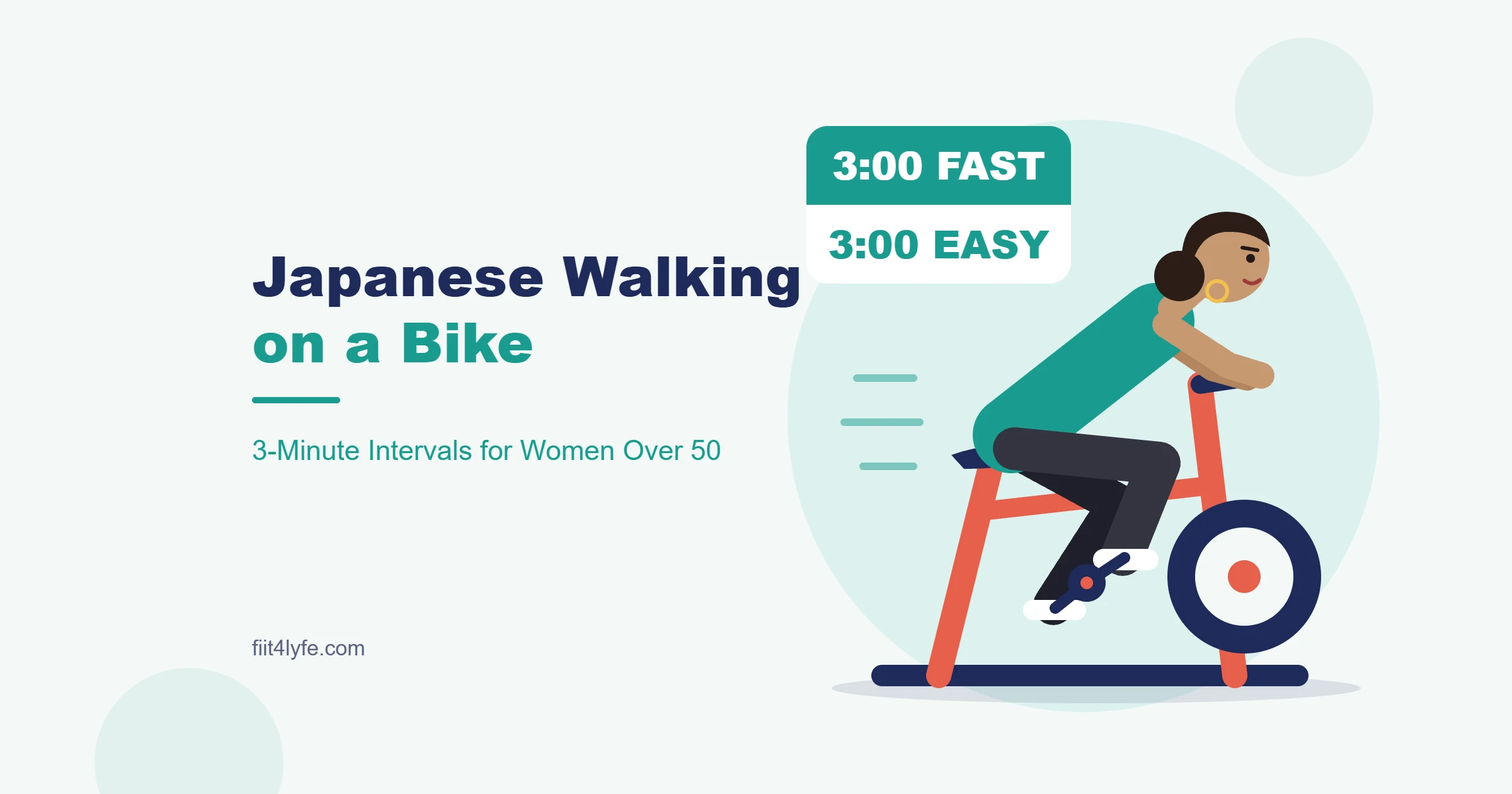
Japanese walking is interval walking: 3 minutes at a pace that feels somewhat hard, then 3 minutes easy, repeated 5 times, about 4 days a week. In a 5-month trial that enrolled 246 adults averaging 63, it improved aerobic fitness, thigh strength, and blood pressure more than steady walking. You can use the same 3-and-3 pattern on an indoor bike by raising the resistance for the fast minutes, a low-impact option for women over 50.
What is Japanese walking?
Japanese walking is the nickname for interval walking training, a method developed by researchers Hiroshi Nose and Shizue Masuki at Shinshu University in Japan. You alternate 3 minutes of walking that feels somewhat hard with 3 minutes of easy walking, for at least 5 rounds, about 4 days a week.
The name is new. The method isn’t. The team has studied it for about 20 years, since the early 2000s, and the 2026 trend is mostly that research with a catchy label.
Why intervals instead of one steady pace? The fast minutes push your heart, lungs, and legs harder than a steady stroll can, and the easy minutes let you recover so you can do it again. In the research, the fast minutes aimed for about 70% of each person’s peak aerobic capacity, and the slow minutes about 40%. In plain terms: the fast part should feel like real work, and the slow part should feel like a true break.
What did the research find?
In the trial that started it all, adults who did interval walking for 5 months gained more fitness, thigh strength, and blood pressure benefit than adults who walked at a steady, moderate pace. Most of the volunteers were women, with an average age of 63, so the results speak directly to us.
You’ll find the numbers in the case file below. The short version: how hard you move matters, not just how much.
Can you do Japanese walking on a stationary bike?
Yes. Use the same pattern, 3 minutes somewhat hard and 3 minutes easy, and change the resistance instead of your walking speed. One honest note: the big trials tested walking, not cycling. The bike version uses the same interval idea with less impact on your knees, hips, and feet, and no weather to work around.
It’s a fair bridge. In the original trial, researchers measured fitness on a bike as well as while walking, and the interval group improved on both.
The bike also makes the fast minutes easy to control. Turn the resistance knob up until the pedals feel heavy and your breathing picks up, then turn it back down for the easy minutes. Keep your cadence, or pedal speed, steady and let the resistance do the work.
I use interval training too, usually as part of a guided workout program. On the bike, the 3-minute version is a nice middle ground between my easy rides and short, hard bursts.
How hard should the fast minutes feel?
About 6 to 7 out of 10, where 0 is sitting still and 10 is your hardest effort. That’s roughly what the researchers’ target of 70% of each person’s peak capacity feels like for most people, and it sits where moderate effort turns vigorous on the 0 to 10 scale used in the federal activity guidelines. You should be able to say a short phrase, but not hold a full conversation. The easy minutes should feel like a 3 or 4: breathing settles, and you could chat comfortably. If the fast minutes feel easy, they’re too easy.
That last part is the most common mistake. A ride with a few slightly faster stretches won’t do what the research did. The fast minutes need to feel like real effort.
The talk test is the simplest guide. My post on how to breathe while cycling explains how to use it.
What does a 30-minute Japanese walking ride look like?
Warm up for 5 minutes, then ride 5 rounds of 3 minutes somewhat hard and 3 minutes easy, and finish with a 5-minute cool-down. That’s 40 minutes start to finish, with 30 minutes of intervals. If that’s too much right now, start with 3 rounds and build up.
| Part | Time | How it should feel |
|---|---|---|
| Warm-up | 5 minutes | Easy, light resistance, 2 to 3 out of 10 |
| Fast minutes | 3 minutes | Somewhat hard, heavier resistance, about 6 to 7 out of 10 |
| Easy minutes | 3 minutes | Easy, light resistance, 3 to 4 out of 10 |
| Repeat | 5 rounds total | Fast, then easy, five times |
| Cool-down | 5 minutes | Very easy, then stop and stretch |
Beginner version: 3 rounds of 2 minutes somewhat hard and 3 minutes easy. Add a round each week, then stretch the fast minutes to 3.
If your legs feel stiff before you start, use my 8-minute warm-up first.
How often should you do it, and how does it fit with strength days?
The research used at least 4 days a week. You don’t have to start there. Two interval rides a week is a solid beginning, with easy rides and strength days in between. Keep your hardest interval ride and your hardest leg day on different days so your legs can recover.
Here’s one way to fit it together:
| Day | Plan |
|---|---|
| Monday | Japanese walking ride |
| Tuesday | Upper-body strength |
| Wednesday | Easy ride |
| Thursday | Lower-body strength |
| Friday | Japanese walking ride |
| Saturday | Longer easy ride |
| Sunday | Rest |
Last week I shared how to add strength training to your bike week. This plan slots interval rides right into that week.
There’s one more reason to keep those strength days. A 2024 study from the same Shinshu team followed 234 women past menopause who did interval walking for 5 months. The women who started with lower bone density saw it improve, while those who started higher held steady. The study didn’t have a comparison group or test why, but walking puts weight and impact on your bones in a way the bike doesn’t. So on the bike, your strength days do that job.
How is this different from HIIT or Zone 2?
Japanese walking sits in the middle. Zone 2 is a steady, easy pace you could hold for a long time while chatting. HIIT uses short, hard bursts, like 30 seconds, with longer recovery. Japanese walking uses longer, 3-minute efforts that feel somewhat hard, not all-out, which many women over 50 find easier to start and stick with.
You don’t have to pick just one. If you like short bursts, my low-impact HIIT intervals are a good fit for one day a week. Japanese walking rides can fill another, and easy rides fill the rest.
A personal note: high blood pressure hit me in my 40s, and my numbers have been normal for nearly ten years. That came from changing how I eat and move overall, not from any one method, and certainly not from a trend. But it’s why research on blood pressure always gets my attention.
| The Myth | The Precision Standard |
|---|---|
| Japanese walking is a new trend | It comes from 20 years of research at Shinshu University |
| Any walk with a few fast steps counts | The fast minutes should feel about 6 to 7 out of 10 |
| You need nice weather and a park | The same pattern works on an indoor bike |
| Harder is always better | 3 minutes somewhat hard, then a real recovery |
| 10,000 steps is the goal | How hard you move matters, not just how much |
Here’s your Daily Win: on your next ride, do 3 rounds of 3 minutes somewhat hard and 3 minutes easy. Rate each fast round from 0 to 10, and write the numbers down.
Forensic Case File: What happened when researchers put interval walking up against steady walking
Let’s look at the evidence. In 2007, Shinshu University researchers published a trial in Mayo Clinic Proceedings that enrolled 246 middle-aged and older adults, 186 of them women, average age about 63. They were split into three groups for 5 months: no training, steady walking at a moderate pace, or interval walking.
The interval walkers did at least 5 rounds of 3 minutes fast and 3 minutes slow, at least 4 days a week. They came out ahead. Their thigh strength rose about 13% for straightening the knee and about 17% for bending it. Their peak aerobic capacity, a measure of how much oxygen your body can use, rose about 8% on a bike test and about 9% on a walking test. Their systolic blood pressure, the top number, dropped more than it did for the steady walkers.
Now the honest limits. The volunteers were Japanese adults from one region, much of the research comes from one team, and the trial tested walking, not cycling. Here’s what I take from it: changing how hard you work, a few minutes at a time, can make the same amount of exercise count for more.
Bottom line: Japanese walking is 3 minutes somewhat hard and 3 minutes easy, 5 times, about 4 days a week, and research in older adults shows it builds fitness and leg strength and lowers blood pressure more than steady walking. On an indoor bike, you can follow the same pattern with less impact by turning up the resistance for the fast minutes.
Frequently Asked Questions
Is Japanese walking good for women over 50?
It can be. Most volunteers in the original trial were women, with an average age of 63, and they gained fitness and leg strength in 5 months. Start with fewer rounds if you’re new to exercise, and check with your doctor first if you have a heart condition or high blood pressure.
Can Japanese walking lower blood pressure?
In the 2007 trial, interval walkers’ systolic blood pressure dropped more than steady walkers’ did. That’s an average across a group, not a promise for any one person. If you have high blood pressure, keep taking any medicine as prescribed and talk to your doctor before you add harder intervals.
How long until I see results?
The main trial measured results after 5 months. You may find the fast minutes start to feel a little easier sooner than that, which is a good sign to turn the resistance up slightly. Keep a simple log of your effort numbers so you can see the change.
Can I do Japanese walking on a treadmill or outside instead?
Yes. The research was done with walking in everyday settings, and a treadmill works too. Use the same 3-and-3 pattern. Walking adds the bone-loading impact the bike doesn’t, so mixing both can be a smart choice if your joints allow it.
Is it safe if I have knee pain?
The bike is usually gentler on knees than fast walking, but check your bike setup first and keep the resistance where you can pedal smoothly. If a fast round causes knee pain, lower the resistance. See your doctor if the pain continues.
Have you tried Japanese walking yet? Tell me in the comments.
Want the newest research in plain English? I track it for you on my Over-50 Fitness Research Tracker, updated monthly.
New to indoor cycling, or getting back to it? Get my free printable plan, Your First 4 Weeks of Low-Impact Riding, with a bike setup checklist and a ride-by-ride schedule.
For a new low-impact workout idea every week, follow me @FiitTalk on Instagram and TikTok.
I’m a certified fitness professional, not a doctor, and this article is for general education, not medical advice. Please check with your doctor before starting any new exercise program, especially if you have high blood pressure, a heart condition, joint problems, or take medicine that affects your heart rate.
Sources
- Nemoto K, Gen-no H, Masuki S, Okazaki K, Nose H. Effects of high-intensity interval walking training on physical fitness and blood pressure in middle-aged and older people. Mayo Clinic Proceedings, 2007;82(7):803-811. doi:10.4065/82.7.803
- Martyanti RN, Morikawa M, Hanaoka M, Tanaka S, Nakamura Y, Nose H, Masuki S. Increased response of postmenopausal bone to interval walking training depends on baseline bone mineral density. PLoS One, 2024;19(9):e0309936.
- U.S. Department of Health and Human Services. Physical Activity Guidelines for Americans, 2nd edition, 2018.
- Shinshu University. “Interval walking extends healthy lifespan,” research highlight, April 2025.