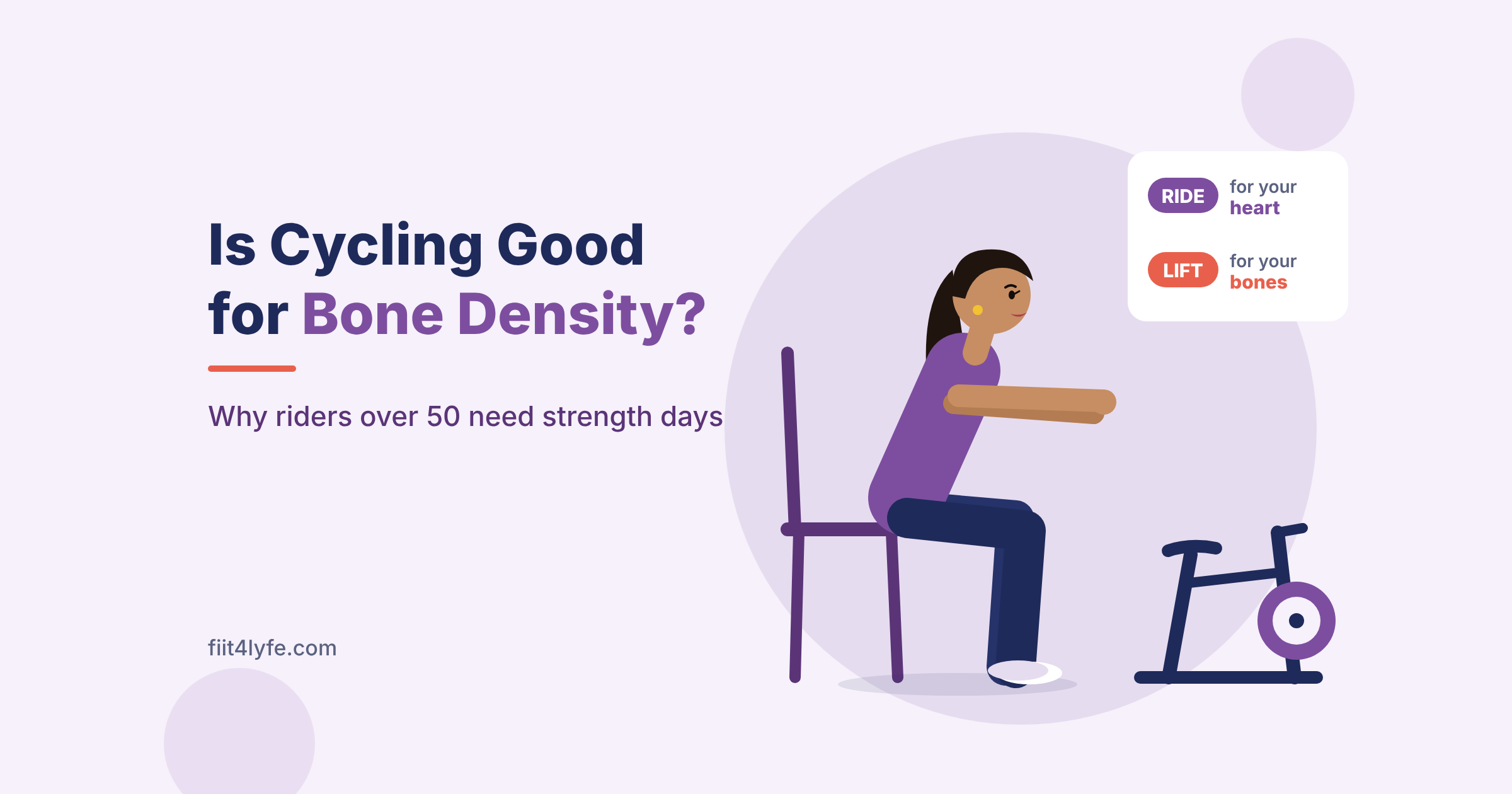
Is Cycling Good for Bone Density? Why Riders Over 50 Need Strength Days
You ride four days a week. You feel strong. Then your doctor brings up a bone density scan, and you think, I’m active. Shouldn’t my bones be fine?
So, is cycling good for bone density? Here’s the honest answer, and the simple fix.
Cycling is great for your heart and legs, but it does little for bone density because it isn’t weight-bearing. Women over 50 who ride should add strength training at least two days a week, since bones grow stronger when muscles pull on them under load. A 10-minute, no-jump routine at home, like chair squats, wall push-ups, glute bridges, and calf raises, is a safe place to start.
Is cycling good for bone density?
Not on its own. A review of the research on cycling and bone health found that cycling does a lot for heart and lung fitness but little or nothing for bone mass. The reason is simple. The seat holds your weight, so your bones don’t have to. Keep riding for your heart. Add strength work for your bones.
That doesn’t make the bike bad. It means the bike has a job, and bone isn’t it. Your heart, lungs, mood, and blood sugar all benefit from riding. Your bones need something more.
I learned this the long way. When I started my own health journey, I did lots of cardio: the elliptical, cycling, and long walks. With no strength training, I was turning into a string bean, and fast. Once I added regular strength work, I gained muscle I never knew I had, and the pain in my neck and back eased up. Now I can always tell when I’ve slacked on strength days. My joints start to hurt and I start losing muscle.
Why do women lose bone faster after 50?
Estrogen helps keep bone strong. When it drops at menopause, the body breaks down old bone faster than it builds new bone. Bone loss is fastest in the first five to seven years after menopause. That’s why the years after 50 are the time to give your bones a reason to stay strong.
Bone is living tissue. It responds to what you ask of it. Ask very little, and it slowly lets go. Give it regular, steady challenge, and it holds on.
What kind of exercise builds bone after 50?
Strength training and weight-bearing exercise. When your muscles pull on your bones under load, your bones respond by getting stronger. A 2026 study of 251 adults found that people with stronger legs had denser hip bones at every age. Walking helps too, but strength work adds the extra challenge bones need.
That’s why I pair the bike with strength days instead of choosing one. The bike keeps my heart strong. The strength days look out for my bones and joints.
Is it safe to strength train with low bone density?
For most women, yes. Mayo Clinic lists strength training among the recommended activities for osteoporosis. The key is slow, controlled moves. With osteoporosis, Mayo Clinic advises skipping high-impact moves like jumping and running, and moves that bend or twist your spine, like sit-ups and toe touches. Talk to your doctor first about what’s right for you.
If you’ve had a fracture or a scan that showed low bone density, a physical therapist can help you set up a plan. Then you can build from there with confidence.
What’s a simple bone-strengthening routine I can do at home?
Four moves, no equipment, about 10 minutes: chair squats, wall push-ups, glute bridges, and calf raises holding a chair. Do 10 of each, rest a minute, and repeat for three rounds. Once it feels easy, hold light dumbbells to keep challenging your muscles and bones.
| Move | How to do it | Reps |
|---|---|---|
| Chair squat | Sit down slowly, then stand back up, pushing through your heels | 10 |
| Wall push-up | Hands on the wall at shoulder height. Bend your elbows, then press back | 10 |
| Glute bridge | Lie on your back, feet flat. Squeeze your seat and lift your hips | 10 |
| Calf raise | Hold the back of a chair. Rise onto your toes, then lower slowly | 10 |
One round takes about three minutes. Rest for a minute, then go again. If anything hurts, stop. For more on bridges, see my 5-minute glute activation routine.
How do you fit strength days into a riding week?
Put two strength days on non-riding days or after an easy ride. A simple week: ride Monday, strength Tuesday, ride Wednesday, rest Thursday, strength Friday, ride Saturday, rest Sunday. Federal guidelines call for muscle-strengthening work at least two days a week, and ten minutes counts, even on a busy holiday week.
Thanksgiving week is a great test. The house is full, the oven is on, and the bike may sit for a day. Ten minutes on the living room floor still keeps your week on track. For a fuller weekly plan, see how to add strength training to your bike week.
| The Myth | The Precision Standard |
|---|---|
| I ride, so my bones are fine | Ride for your heart, lift for your bones |
| You need a gym to build bone | Ten minutes in your living room counts |
| Jumping is the only way to build bone | Slow, controlled strength moves are a safe start |
| Lifting makes you bulky | Two short sessions a week keep you strong, not bulky |
| It’s too late after menopause | Bones and muscles still respond at any age |
Here’s your Daily Win: do one round of the 10-minute routine on a non-riding day this week. Write down which move felt easiest.
Forensic Case File: Stronger legs, stronger hips
Let’s look at the evidence. A 2026 study led by William Kraemer in Medicine & Science in Sports & Exercise tested 251 adults, 149 women and 102 men, ages 18 to 85. Researchers measured leg strength with a one-time maximum leg press, the heaviest weight each person could push once. They measured bone density at the hip and lower spine with a DXA scan, the same scan your doctor uses.
Leg strength was strongly tied to hip bone density. That link held at every age, from young adults to people in their 80s, even after the researchers accounted for age, sex, and body fat. It wasn’t just that heavier people had denser bones. Stronger legs went with stronger hips.
Now the honest limits. This was a snapshot study that measured people once. It shows a link, not proof that building leg strength builds bone. Training studies are needed for that. But it lines up with what I’ve seen in my own body: when I keep my strength days, I feel it in my joints.
Bottom line: Cycling is good for your heart but not your bones, because it isn’t weight-bearing. Women over 50 who ride should add two short strength days a week, with slow, no-jump moves, to help protect bone density.
Frequently Asked Questions
Is a stationary bike weight-bearing?
No. Like outdoor cycling, a stationary bike supports your body weight on the seat, so it puts little load on your bones. It’s still a great low-impact choice for your heart and legs. Pair it with strength training to cover your bones.
Is walking enough for bone density?
Walking is weight-bearing, so it does more for bone than cycling. But for many women over 50, walking alone may not be enough challenge to protect bone. Adding strength training two days a week gives your bones a stronger reason to adapt.
Can I build bone without weights?
Yes, you can start with your body weight. Chair squats, wall push-ups, bridges, and calf raises all put load on your bones. Over time, add light dumbbells or a resistance band so your muscles and bones keep getting a new challenge.
Should I stop cycling if I have osteoporosis?
Not usually. Cycling is low-impact and gentle on your joints, so it’s often a good fit. Ask your doctor what’s safe for you, especially if you’ve had a fracture, and add the strength work your bones need.
How long does it take to improve bone density?
Bone changes slowly. Most studies measure results after six months to a year. You’ll likely notice you feel stronger and steadier much sooner than that, which is a good sign you’re on the right track.
For a new low-impact workout idea every week, follow me @FiitTalk on Instagram and TikTok.
I’m a certified fitness professional, not a doctor, and this article is for general education, not medical advice. Please check with your doctor before starting any new exercise program, especially if you have osteoporosis, a past fracture, or joint problems.
Sources
- Olmedillas H, González-Agüero A, Moreno LA, Casajús JA, Vicente-Rodríguez G. Cycling and bone health: a systematic review. BMC Medicine, 2012;10:168. doi:10.1186/1741-7015-10-168
- Kraemer WJ, et al. Lower-body strength, lean mass, and bone mineral density across the adult lifespan: age- and sex-related associations. Medicine & Science in Sports & Exercise, 2026;58(11):2581-2593. doi:10.1249/MSS.0000000000004074
- Mayo Clinic. Exercising with osteoporosis: Stay active the safe way.
- U.S. Department of Health and Human Services. Physical Activity Guidelines for Americans, 2nd edition, 2018.
- Bone Health and Osteoporosis Foundation. What women need to know.